 AGreenNest
DIY Plant Projects
Make a Terracotta Olla: Buried-Pot Watering That Works
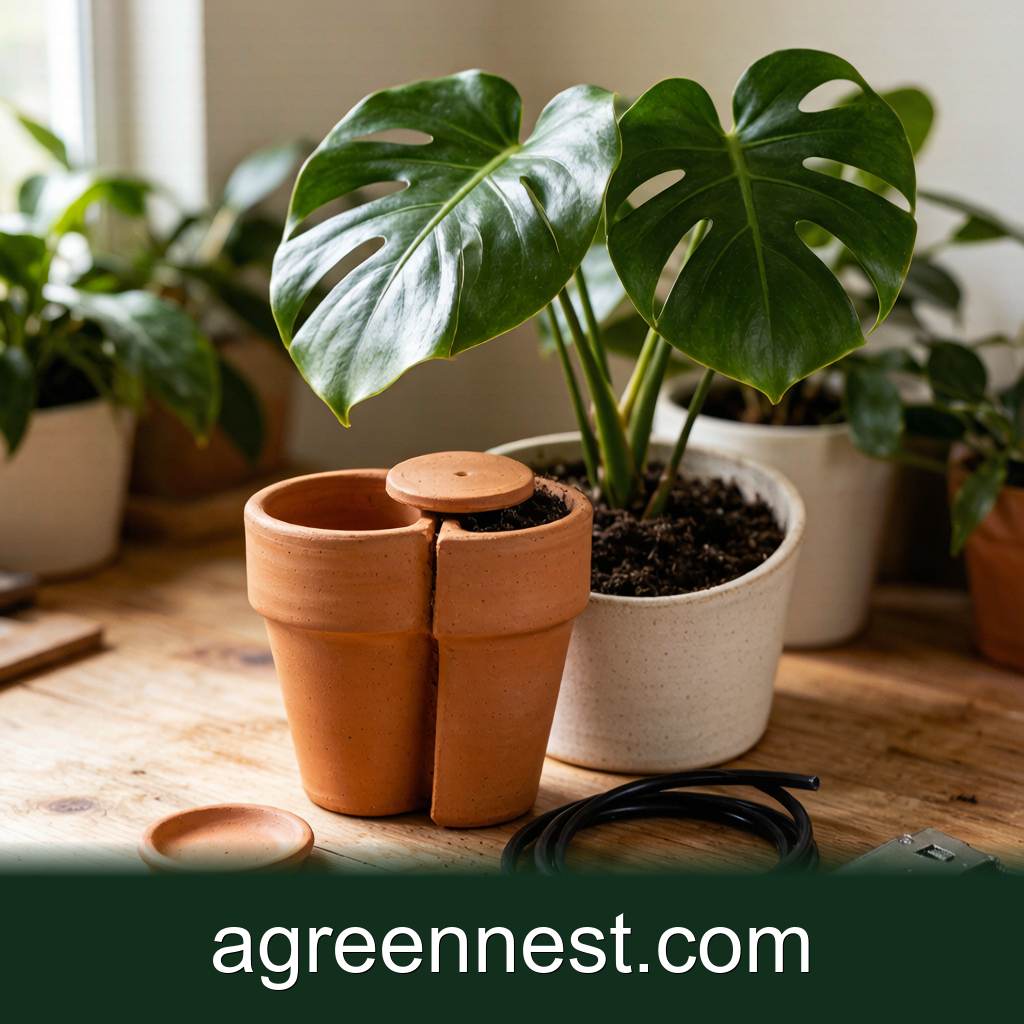
An olla is an unglazed terracotta vessel buried in the pot; water seeps through its porous wall only when the surrounding soil dries. Two 10 cm terracotta pots glued rim to rim make one for about $6. It waters a 30 to 35 cm planter for 5 to 8 days per fill.
Farmers in dry regions have been burying porous clay pots next to crops for well over 2,000 years. The technique survived because the physics is self-correcting: water moves through the unglazed wall only when the soil outside is drier than the clay. Wet soil, no flow. Dry soil, steady flow. No electronics, no valves, no guesswork.
That same principle solves a specific houseplant problem: the big planter. Anything over 25 cm across dries unevenly, reads differently at every probe spot, and takes so long to water properly that most people either flood it or give up and splash a cup in. I run ollas in my three largest planters, a 35 cm Monstera deliciosa, a 40 cm Ficus lyrata, and a mixed herb trough. Refills take 30 seconds a week.
Here is the build. Two terracotta pots, one saucer, waterproof sealant, about $6 in parts and 20 minutes of work plus cure time.
How Does a Buried Clay Pot Know When to Water?
Unglazed terracotta is riddled with microscopic pores. When the vessel is full and buried, soil in contact with the wall pulls water through those pores by capillary suction. The drier the soil, the stronger the pull, and the faster water moves. Once the surrounding soil reaches roughly field capacity, suction drops to near zero and seepage stops on its own.
That negative-feedback loop is what spikes and gravity drippers lack. A self-watering spike meters water at a fixed drip rate whether the soil needs it or not, and a capillary mat needs the pot sitting on a tray. The olla only responds to demand, which is why root rot from an olla is rare as long as you size it sensibly. If your planter already smells swampy, deal with that first: root rot triage here.
Roots also grow toward the buried vessel and mat against the damp clay, so after a month the water is delivered almost straight to the root zone instead of evaporating off the surface.
What Size Olla Does Your Planter Need?
Working rule from my own pots: the olla should hold roughly 8 to 12 percent of the planter's soil volume, and its wall should sit 5 to 10 cm from the planter edge.
| Planter diameter | Olla build | Capacity | Typical refill |
|---|---|---|---|
| 25-30 cm | two 8 cm pots | ~0.4 L | every 4-6 days |
| 30-38 cm | two 10 cm pots | ~0.7 L | every 5-8 days |
| 40-50 cm | two 13 cm pots | ~1.4 L | every 6-9 days |
| Trough 60 cm+ | two ollas, spaced | 2 x 0.7 L | weekly |
Two caveats. First, the clay must be plain unglazed terracotta; glazed or painted pots seal the pores and nothing seeps. Second, refill frequency swings with season and plant. My ficus empties its olla in 5 days during a July heat run and takes 11 days in January. The fill level is itself a moisture gauge, which is more useful than it sounds. When in doubt, cross-check with a probe: moisture meter vs finger test covers how to read a big pot properly.
The Build, Step by Step
Materials:
- Two matching unglazed terracotta pots, 10 cm rim diameter ($2 each). Grab a spare while you are at it; cheap terracotta cracks.
- One terracotta saucer that covers the top hole, or a flat stone
- Waterproof, plant-safe sealant: aquarium-grade silicone or two-part epoxy
- A scrap of cork, a rubber bung, or extra silicone to plug one drainage hole
Steps:
- Wash both pots and let them dry fully. Silicone will not bond to damp or dusty clay.
- Plug the drainage hole of ONE pot. Press a bead of silicone across the hole from the inside, smooth it flat, and add a second bead outside. This becomes the bottom.
- Run a continuous 5 mm bead of silicone around the rim of the bottom pot. Press the second pot rim to rim on top, rotate 5 degrees to spread the bead, and wipe the squeeze-out.
- Cure 24 hours minimum, 48 if the label says so. Rushing this step is the number one cause of leaks.
- Leak test: hold the open top hole under a tap, fill, and stand the olla in a dry sink for an hour. The wall should darken evenly as it wicks; the rim joint should stay drip-free.
- Bury it in the planter with only the top hole and 1 to 2 cm of shoulder above the soil line, 5 to 10 cm from the pot edge. Backfill firmly; air gaps around the wall stop capillary contact.
- Fill through the top hole and cap it with the saucer. The cap matters: an open hole loses water to evaporation and breeds fungus gnats.
Total cost for my 0.7 L unit: $6.40. A commercial olla of the same capacity runs $18 to $25.
Why Not Just Use a Watering Spike or a Self-Watering Planter?
Different tools for different pots, and I use all three.
Spikes win in pots under 20 cm where an olla would crowd the roots. Their weakness is the fixed drip rate. Self-watering planters with a reservoir are the tidiest long-term answer, but converting an existing 40 cm planter means repotting a large, settled plant, and a full build is a bigger weekend project. The olla retrofits into an occupied planter with a trowel and ten minutes.
Ollas lose in two situations. Succulents and cacti want a hard wet-dry swing that constant capillary supply denies them, so keep ollas out of those pots. And in soft, peat-heavy mixes the clay can over-deliver in the first week while the soil settles; check daily until the refill rhythm stabilises.
One maintenance note: minerals from tap water slowly clog the pores. Once or twice a year, pull the olla, soak it overnight in 1:4 white vinegar, scrub, and rinse. Seepage rate comes right back.
Frequently Asked Questions
Q: My olla empties in two days. Is that normal?
A: In the first week, yes; dry backfill soil pulls hard until it equilibrates. If it persists past two weeks, either the olla is undersized for the planter (see the table above) or the rim joint is leaking. Re-run the sink test to rule out the joint.
Q: The water level barely drops at all. What went wrong?
A: Three usual causes: the pot is glazed or sealed clay rather than raw terracotta, air pockets around the wall are breaking soil contact, or the soil is already wet. Repack the backfill firmly and let the planter dry down once before judging.
Q: Can I add liquid fertiliser to the olla water?
A: At quarter strength, occasionally, yes, but salts clog pores faster and you will need the vinegar soak more often. I fertilise from the top at normal watering strength and keep the olla as plain water.
Q: Will the olla crack if I leave it in an unheated room over winter?
A: If the water inside freezes, almost certainly. Below about 5 °C, empty it and leave the cap off. Indoors at normal room temperature there is no risk.
Q: Do fungus gnats breed in the olla?
A: Not in a capped olla; the adults cannot reach the water. An uncapped top hole is an open invitation, so keep the saucer on. The constantly moist soil ring near the olla shoulder can host larvae in peaty mixes; a 2 cm gravel or sand top-dress over that zone shuts it down.
An olla is the rare DIY project that outperforms the commercial version at a third of the price, because the material doing the work is the same $2 clay either way. Size it to the planter, seal the joint properly, cap the hole, and big-pot watering turns into a weekly 30-second refill. To find out how much water your planter actually consumes between fills, run the numbers with our free watering calculator.
Sources & further reading
GreenNest authors research and write every guide independently. The external links below are reputable references we recommend for deeper reading — they are not the sources we copied from.
- Michigan State University — College of Agriculture & Natural Resources — Michigan State University
- University of Minnesota Extension — U Minnesota Extension
- NC State Extension Plant Toolbox — NC State Extension
Recommended Tools for DIY Plant Projects Care
Free, no-signup helpers matched to this guide.
Free Ebooks to Explore
Downloadable handbooks — no email required.
Free Ebook
The AGreenNest Succulent Care Handbook
The complete, beginner-to-confident guide to growing fat, happy succulents — 10 chapters and a 20-plant directory.
Free Ebook
Haworthia & Haworthiopsis Care Handbook
A focused guide to the striped, forgiving Haworthia clan.
Share Your Plant Story
Grown something tricky, or found a trick that finally worked? Tell us in the comments, or see what other readers are sharing on our Community page. The best reader tips get folded back into our guides.
Join the Conversation
Have a tip or a question about Make a Terracotta Olla: Buried-Pot Watering That Works? Share it below — comments are saved on our server.