 AGreenNest
Plant Care Accessories
PAR Meter vs Lux App: Which Reading Can You Trust?
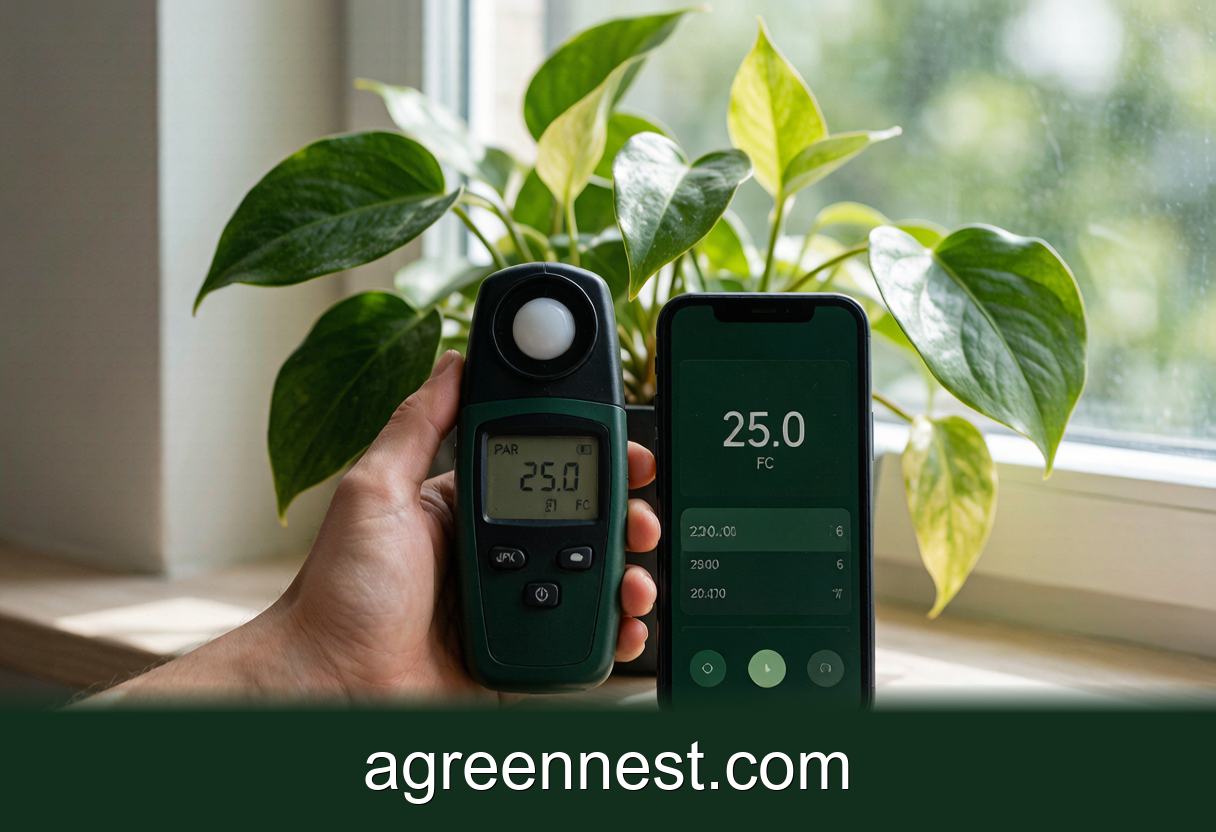
A phone lux app is accurate enough for daylight if you divide lux by 54 to estimate PPFD, but it misreads LED grow lights badly because lux weights green and ignores deep red. Use the app for windows, and the manufacturer's PPFD chart or a quantum meter for lamps.
My phone read 640 lux under a red-heavy LED bar. The quantum sensor lying beside it read 84 µmol/m²/s. Run the standard daylight conversion on that 640 lux figure and you get 12. Neither instrument was broken. They measure different physics, and under the wrong lamp that gap is a factor of seven.
Here is what each tool measures, the conversion numbers that make a free phone app genuinely useful, and the one situation where the app belongs in the bin.
Lux and PPFD Are Not the Same Quantity
Lux is a human unit. It weights every wavelength by the photopic curve, the sensitivity of the average eye, which peaks at 555 nm in the green and drops away hard at both ends of the spectrum. Deep red at 660 nm registers at about 6 percent of that peak. Blue at 450 nm is not much better.
PPFD, photosynthetic photon flux density, counts photons between 400 and 700 nm and treats them as roughly equal, because chlorophyll does not share the eye's preferences. It is reported in µmol/m²/s. A red photon and a green photon are both one photon.
That single difference drives everything below. Daylight has a broad, smooth spectrum, so lux and PPFD track each other closely and a conversion works well. Narrow-band grow lights break the relationship.
What Does the Conversion Factor Actually Look Like?
Divide your lux reading by the factor for that light source to approximate PPFD:
| Light source | Lux per µmol/m²/s |
|---|---|
| Daylight through a window | 54 |
| White LED, 3000 to 5000 K | 70 to 75 |
| Cool white fluorescent | 74 |
| High pressure sodium | 82 |
| Deep red 660 nm LED | about 8 |
Read the bottom row twice. A purple "blurple" fixture built from 660 nm red and 450 nm blue diodes throws very few lumens per photon, so a lux app under-reports it badly. My 640 lux reading was really 84 µmol/m²/s of usable light. Had I trusted the divide-by-54 habit, I would have written that shelf off as a dark corner and moved a healthy Ficus lyrata out of a good spot.
How Accurate Is a Phone Light Sensor?
Better than people expect at relative readings, worse than people hope at absolute ones.
The ambient light sensor in a phone is a small silicon photodiode behind a filter that approximates the photopic curve. It exists to dim your screen, not to do photometry. Three problems follow. Calibration varies between handsets, so two phones on the same windowsill can differ by 15 to 30 percent. There is no cosine correction, because the sensor sits behind flat glass, so light arriving at a steep angle gets under-counted. And the sensor usually hides near the earpiece, where half of us shade it with a thumb without noticing.
What a phone does well is comparison. Same handset, same orientation, five spots in one room, ten minutes apart: those numbers are reliable relative to each other, and that is the question most people actually have. Which shelf is brightest? The app answers that. How many photons is my Calathea orbifolia receiving? Much less confidently.
Do You Need a Quantum PAR Meter?
Most people do not. Here is where the money goes.
A true quantum sensor with a cosine-corrected diffuser and a flat 400 to 700 nm response starts around $250 and runs to $400 for a full-spectrum unit. It is the right buy if you run narrow-band LED fixtures, if you are dialling in a propagation rack where a 20 percent error changes the outcome, or if you sell plants and need repeatable numbers.
Be wary of the $40 "PAR meters" on marketplace listings. Almost all of them are lux meters with a fixed divisor baked into the firmware, usually the daylight 54. Under an LED they inherit every error described above and then hide it behind a µmol label, which is worse than an honest lux figure.
The middle path costs nothing: use your fixture manufacturer's PPFD chart. Any lamp worth buying publishes a grid of readings at set distances, taken with a real sensor. Cross-check that against how far to hang grow lights and you have a usable number without owning a meter.
The Numbers Worth Aiming For
Targets in µmol/m²/s, measured at leaf height:
- 20 to 50: survival only. Zamioculcas zamiifolia and Sansevieria trifasciata persist here and grow almost nothing.
- 50 to 150: slow, steady growth for most low light tropicals.
- 150 to 300: the sweet spot for Monstera deliciosa, philodendrons, and aroids generally.
- 400 to 700: what Echeveria elegans and other succulents need if you want tight rosettes instead of pale, stretched ones.
Daily light integral matters more than any single snapshot, because a plant totals photons across the whole day. Multiply PPFD by hours of light, then by 0.0036, for mol/m²/day. So 180 µmol over 12 hours is 7.8 mol/m²/day, comfortable for aroids. Succulents want 12 to 20. A 200 µmol reading that lasts only 4 hours gives 2.9, which is exactly why a bright but brief patch of afternoon sun disappoints people. Getting the photoperiod wrong is one of the common grow light mistakes that no meter will catch for you.
How to Take a Reading You Can Repeat
Lay the phone flat, screen up, at the height of the top leaves. Not on the floor, not pressed against the glass. Step aside so you are not casting a shadow. Take three readings across the plant's footprint and use the middle value.
Log the time and the weather too, because the same north window swings from 400 lux on a grey morning to 2,500 lux at noon in June. For a baseline you can compare month to month, measure at the same hour on an overcast day. Diffuse cloud light is far steadier than direct sun, which shifts with every passing cloud. I keep one note per room and re-measure at the equinoxes. The autumn drop catches people out every year, and it explains why plants that coasted through July start shedding leaves in October. The full method is in the lux test for your home, and if you are still choosing hardware, LED versus fluorescent covers output per watt.
Frequently Asked Questions
Q: My phone and my partner's phone give different lux readings in the same spot. Which is right?
A: In absolute terms, probably neither. Handset sensors are calibrated for screen dimming and commonly differ by 15 to 30 percent. Pick one phone and use it for every reading, so your room-to-room comparisons stay consistent.
Q: Can I convert lux to PPFD under a purple blurple LED?
A: Not reliably. Deep red 660 nm light produces roughly 8 lux per µmol against daylight's 54, so the correct divisor swings with the exact diode mix in your fixture. Use the manufacturer's PPFD chart or a quantum sensor.
Q: Should I measure at the window or at the plant?
A: At the plant, at the height of the top leaves, sensor facing up. Light falls off fast with distance, and a spot 1 m back from a bright window often reads a quarter of the value at the glass.
Q: What DLI should I target for a Monstera under a grow light?
A: Around 8 to 12 mol/m²/day. At 200 µmol/m²/s that means an 11 to 17 hour photoperiod, so a 12 hour timer at 200 lands comfortably mid range. Extend the hours before you add intensity.
Use the phone for what it is good at: ranking spots in your own home and tracking one shelf across the seasons. Apply divide-by-54 under daylight, divide-by-72 under white LEDs, and stop converting altogether under narrow-band purple fixtures. To work out the target for a specific plant and window, run the numbers through our free light calculator or the grow light PAR estimator.
Sources & further reading
GreenNest authors research and write every guide independently. The external links below are reputable references we recommend for deeper reading — they are not the sources we copied from.
- Michigan State University Extension — Michigan State University
- NC State Extension Plant Toolbox — NC State Extension
- University of Minnesota Extension — U Minnesota Extension
Recommended Tools for Plant Care Accessories Care
Free, no-signup helpers matched to this guide.
Free Ebooks to Explore
Downloadable handbooks — no email required.
Free Ebook
The AGreenNest Succulent Care Handbook
The complete, beginner-to-confident guide to growing fat, happy succulents — 10 chapters and a 20-plant directory.
Free Ebook
Haworthia & Haworthiopsis Care Handbook
A focused guide to the striped, forgiving Haworthia clan.
Share Your Plant Story
Grown something tricky, or found a trick that finally worked? Tell us in the comments, or see what other readers are sharing on our Community page. The best reader tips get folded back into our guides.
Join the Conversation
Have a tip or a question about PAR Meter vs Lux App: Which Reading Can You Trust?? Share it below — comments are saved on our server.