 AGreenNest
Plant Care Accessories
How to Hang a Plant Safely: Hooks and Anchors
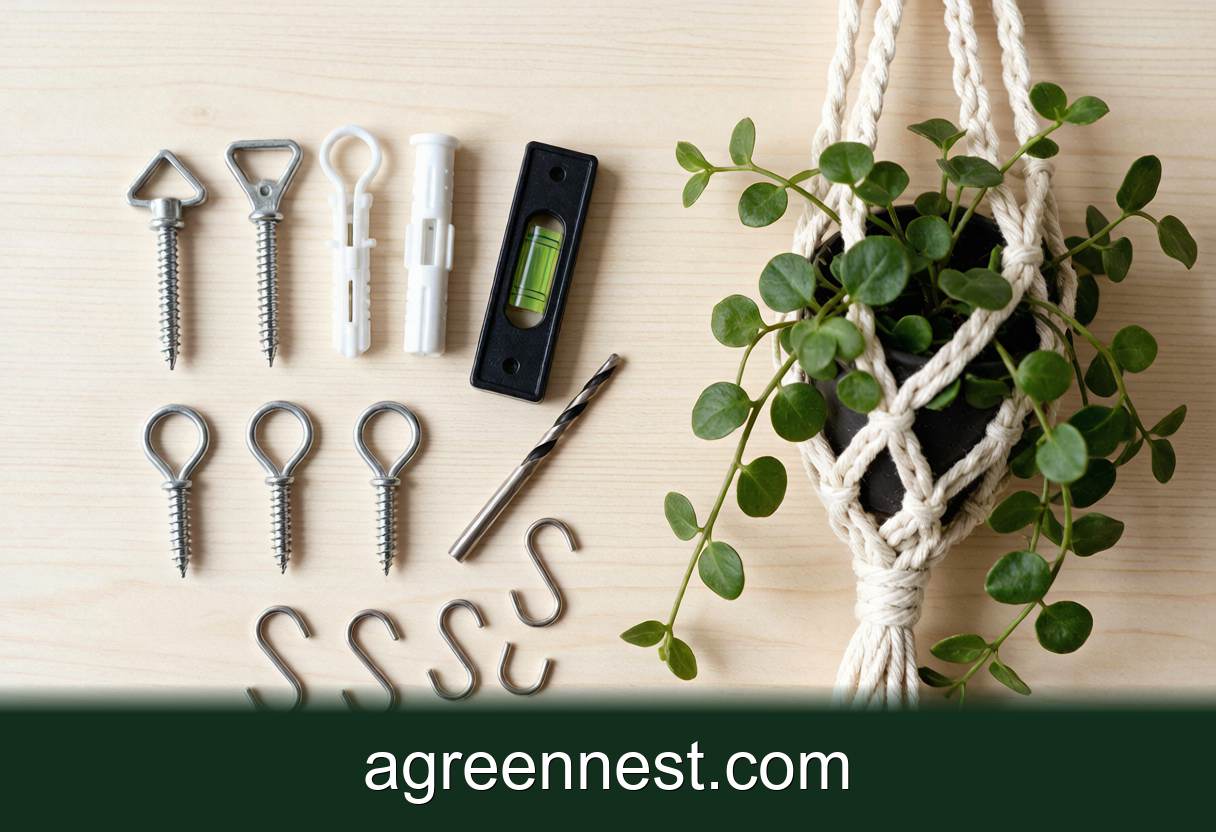
A hanging houseplant weighs two to three times more after watering, so size the hardware for the wet weight plus a safety factor. A 25 cm pot of soaked potting mix runs 7 to 8 kg. Screw into a joist where you can, use a toggle bolt in drywall, and never trust a plastic push-in anchor.
At 2:14 on a Tuesday morning my Epipremnum aureum hit the floor. The plastic push-in anchor had come out of the plasterboard with a neat cone of white dust still attached, three weeks after I hung it. Nothing broke except the pot, but the crater in the ceiling took an afternoon to fix.
The anchor was rated for 9 kg. The plant weighed 4.2 kg dry. I had watered it in place that evening.
That gap between the number on the packet and what your ceiling actually experiences is the whole subject of this guide.
How Much Does a Hanging Plant Really Weigh?
Weigh a pot before and after watering once and you stop guessing forever. Here are my kitchen-scale numbers for standard nursery pots in peat-based mix:
| Pot diameter | Dry weight | Soaked weight |
|---|---|---|
| 15 cm | 0.9 kg | 1.8 kg |
| 20 cm | 2.1 kg | 4.3 kg |
| 25 cm | 3.6 kg | 7.6 kg |
| 30 cm | 6.0 kg | 12.5 kg |
Three things get added on top of that. A glazed ceramic cachepot adds 1.5 to 4 kg on its own, which is why the swap discussed in cachepot versus drainage pot matters structurally and not only visually. A mature trailing plant with 1.5 m of Philodendron hederaceum growth adds another kilo of wet stem. And any pot you water without taking down holds run-off in the saucer.
Then multiply. A hanging load is a dynamic load: it swings when a door slams, and it takes a sharp downward yank every time someone walks into it. Engineers apply a factor for that, and for a domestic ceiling hook I use 3x. So the 25 cm pot at 7.6 kg soaked needs hardware rated for roughly 23 kg, not 8.
Will a Drywall Anchor Hold My Plant?
Sometimes, and never the cheap ones. Ranked by what I actually trust:
Into a joist, always first choice. A 3.5 x 50 mm screw hook driven at least 32 mm into solid timber will hold well over 40 kg in shear and pull-out. This is the only option I use for anything above 5 kg wet.
Toggle bolt, the good fallback. A 5 mm spring toggle in 12.5 mm plasterboard is rated around 25 to 30 kg static. Derate by half for a swinging plant and you have a genuine 12 kg of working capacity. It leaves a 13 mm hole, so commit before you drill.
Self-drilling nylon anchor, small plants only. Packet says 15 kg, reality in soft board is more like 5 kg once you factor movement. Fine for a 15 cm pot of Ceropegia woodii. Not for anything bigger.
Push-in plastic plug: no. That is the one that dropped my pothos.
Concrete ceilings are the easy case: a 6 mm masonry plug with a 5 x 40 mm screw hook, drilled with a hammer bit, holds more than the plant ever will. Lath and plaster is the hard case, because the plaster crumbles and the lath is only 6 mm thick. Find the joist there, or hang from a wall bracket instead.
Finding the Joist Without Wrecking the Ceiling
Joists in most homes sit at 40 cm or 60 cm centres, running perpendicular to the shorter span of the room. Three methods, cheapest first.
Run a strong fridge magnet along the ceiling on a loop of string. It stops on the drywall screws, and those screws are in joists. Mark two hits, and the line between them is your joist. This takes about four minutes and costs nothing.
An electronic stud finder works, but calibrate it on a spot you know is empty and check the reading twice, since ceiling insulation gives false positives.
Then confirm with a 2 mm drill bit. Timber gives continuous resistance and pale shavings. Void gives a sudden drop. A 2 mm hole is invisible from the floor and takes a smear of filler if you miss.
What Goes Between the Ceiling and the Pot?
Hardware failures are rarely the hook, they are the thing hanging off it.
Get a swivel hook rather than a fixed one if the plant is somewhere you brush past. A fixed eye lets the cord twist and abrade, and a twisted macrame hanger loads its cords unevenly. Cotton macrame cord of 4 mm has a breaking strength around 45 kg new, but UV and kitchen humidity take a chunk out of that in two years. I replace kitchen hangers on a three-year cycle. If you are knotting your own, the sizing logic is in our macrame plant hanger project.
An S-hook with a 20 mm gape lets you unhook the whole pot for watering in about four seconds. That single detail is the difference between a plant you maintain and a plant you resent, and it removes the watering-in-place habit that killed my ceiling. Lightweight terracotta or plastic beats glazed stoneware overhead every time.
Also check what the pot rests in. Three-strap hangers grip a tapered pot far better than a flat-bottomed cylinder, and pot geometry is worth a minute of thought before you buy, as covered in pot sizes explained.
Mistakes That Bring Ceilings Down
Watering in place is number one. You are adding 4 kg of shock load to hardware that has been quietly working loose.
Second is drilling into the seam between two drywall sheets. The board edge is weaker, and the tape gives a false sense of solidity.
Third is over-tightening a toggle. Once the spring wings are flat against the board, another half turn crushes the gypsum and the whole thing spins. Snug, then stop.
Fourth is forgetting that the plant grows. A 20 cm pot of Scindapsus pictus that weighed 3 kg when hung can pass 5 kg in a year of good growth. Check hooks each spring, and give them a firm downward tug. Pair that check with the seasonal placement thinking in hanging and trailing plant styling and you will catch problems before gravity does.
Frequently Asked Questions
Q: The ceiling hook creaks when the plant swings. Is that a warning?
A: Yes, treat it as one. A creak in drywall means the anchor is working against a hole that is growing. Take the plant down, move 15 cm to a joist, and fill the old hole. A creak in solid timber is usually the hook thread against the wood, less alarming, but I still back the hook out and add a smear of wood glue before redriving.
Q: Can I hang a plant from a suspended ceiling grid?
A: Not from the grid itself, which is rated for tiles and nothing else. You need a wire dropped from the structural slab above, through a tile, with the load on the wire. Anything else is a false ceiling holding a real weight.
Q: How far apart should two hanging plants be in front of a window?
A: Give each pot 45 to 60 cm of horizontal spacing so foliage does not tangle and airflow stays clear between them. If your hanging pair sits in front of the same pane, offset the heights by 20 cm so the upper plant does not shade the lower one into stretching.
Q: My plaster ceiling has no accessible joists in the right spot. What else works?
A: A wall-mounted swing-arm bracket screwed into two wall studs. It moves the load into vertical timber, which is stronger and much easier to locate, and it lets you swing the plant away from the window for watering.
Hardware is the cheapest part of any hanging display and the only part that can put a hole in your floor. Weigh the pot wet, multiply by three, and buy the anchor for that number. If you want to cut the wet weight itself, adjust how much water the pot needs in the first place with our watering calculator.
Sources & further reading
GreenNest authors research and write every guide independently. The external links below are reputable references we recommend for deeper reading — they are not the sources we copied from.
- Michigan State University — College of Agriculture & Natural Resources — Michigan State University
- University of Minnesota Extension — U Minnesota Extension
- NC State Extension Plant Toolbox — NC State Extension
Recommended Tools for Plant Care Accessories Care
Free, no-signup helpers matched to this guide.
Free Ebooks to Explore
Downloadable handbooks — no email required.
Free Ebook
The AGreenNest Succulent Care Handbook
The complete, beginner-to-confident guide to growing fat, happy succulents — 10 chapters and a 20-plant directory.
Free Ebook
Haworthia & Haworthiopsis Care Handbook
A focused guide to the striped, forgiving Haworthia clan.
Share Your Plant Story
Grown something tricky, or found a trick that finally worked? Tell us in the comments, or see what other readers are sharing on our Community page. The best reader tips get folded back into our guides.
Join the Conversation
Have a tip or a question about How to Hang a Plant Safely: Hooks and Anchors? Share it below — comments are saved on our server.