 AGreenNest
Plant Care Accessories
7 Grow Light Mistakes That Starve Your Plants
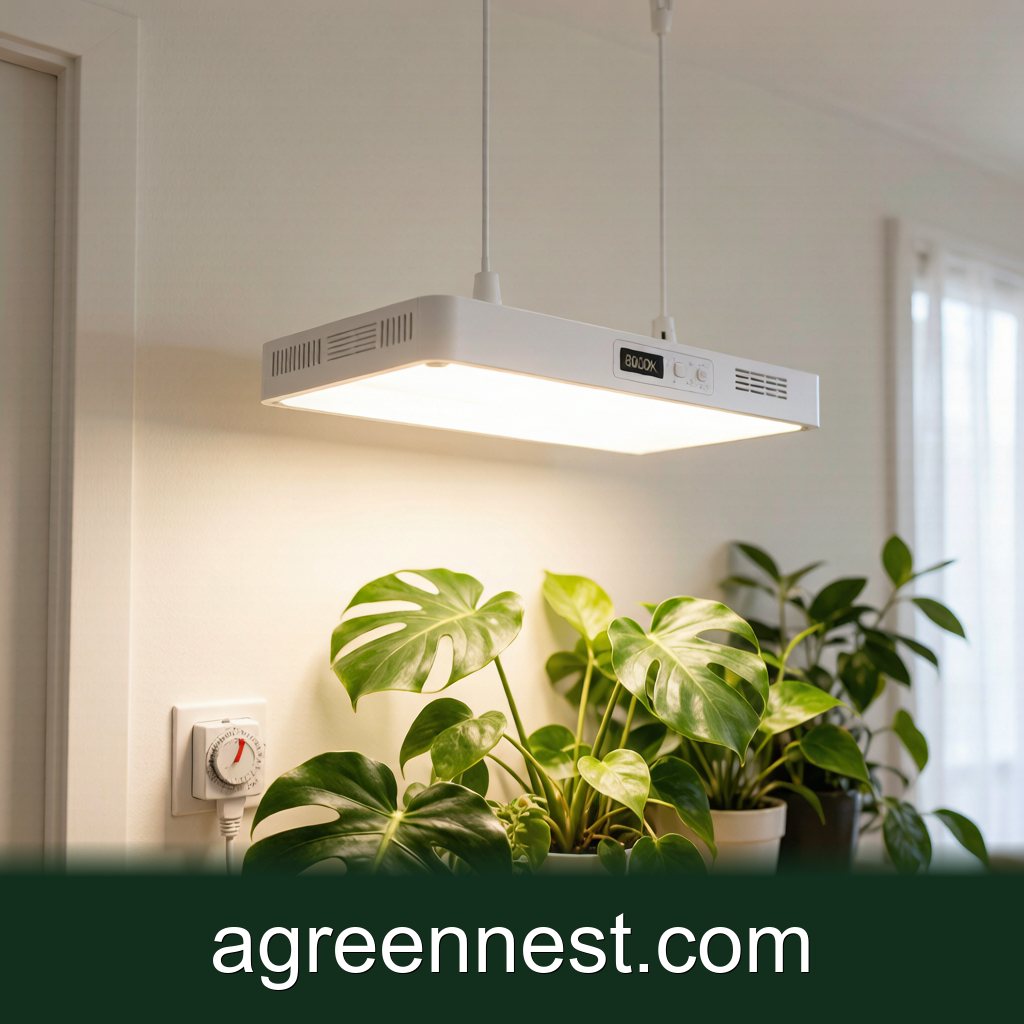
Most grow light failures come from distance and duration, not the light itself. Hang full-spectrum LEDs 30 to 60 cm above foliage, run them 10 to 14 hours on a timer, and judge output by PPFD (aim for 50 to 200 µmol/m²/s for houseplants), not by advertised watts.
A reader mailed me a photo of a leggy, pale Monstera deliciosa sitting directly under a new 45-watt LED panel. Her question: "It's been eight weeks. Why is it worse?" The panel was hanging 1.6 metres above the plant. At that distance, her expensive light was delivering roughly the same photon count as a cloudy afternoon through a north window. The light was fine. The setup was starving the plant.
I have tested north of twenty grow lights, and the pattern holds: when supplemental lighting fails, the hardware is rarely the problem. The same seven mistakes cause nearly every disappointment. Here they are, with the numbers that fix them.
Why Is My Plant Doing Worse Under a Grow Light?
Nine times out of ten: distance. Light intensity falls off with the square of distance, so a panel that delivers 400 µmol/m²/s at 30 cm delivers around 100 at 60 cm and a feeble 25 by 1.2 metres. Doubling the gap does not halve the light; it quarters it.
Working ranges that hold for most full-spectrum LED panels and bulbs:
- Low-light foliage plants (pothos, ZZ, Aglaonema): 30 to 60 cm above the canopy.
- Medium-light plants (Monstera, hoyas, most aroids): 30 to 45 cm.
- Succulents, herbs, seedlings: 15 to 30 cm, assuming the fixture runs cool.
The back-of-hand test is crude but useful: hold your hand at canopy height for 30 seconds. Uncomfortable warmth means too close for foliage plants. For the full distance logic by fixture type, see how far to hang grow lights.
Mistake: Shopping by Watts Instead of PPFD
Watts measure what the fixture pulls from the wall, not what reaches the leaf. Two "60-watt equivalent" bulbs can differ threefold in usable light output. The number that matters is PPFD, photosynthetic photon flux density, in µmol/m²/s at a stated distance. Any manufacturer worth your money publishes a PPFD map; a listing that shouts "1000W equivalent!!" and shows no map is telling you something.
Targets I use:
- Survival for low-light plants: 50 µmol/m²/s
- Steady growth for most houseplants: 100 to 200
- Seedlings and herbs: 200 to 400
No quantum meter? For white LEDs, a phone lux reading divided by about 70 gives a rough PPFD estimate. Blunt, but it catches the tenfold shortfall most setups have. Point the phone at the canopy, take the reading, do the division. Details on measuring are in our home lux test guide.
Can You Leave a Grow Light On 24/7?
No, and this mistake is more common than you'd think, usually born of the logic "more light, more growth." Plants run day-length-dependent processes at night: starch mobilisation, some repair pathways, and in many species the dark period gates flowering. Constant light stresses most houseplants, shows up as bronzed or curled foliage within weeks, and wastes electricity delivering photons past the point of diminishing returns.
Run 10 to 14 hours for foliage plants, 12 to 16 for seedlings and light-hungry herbs. And put it on a timer. A $10 mechanical timer beats your memory every single week of the year; my own schedule is 07:00 to 19:00, set once in autumn and forgotten. Setup steps are in the grow light timer guide.
The mirror image of this mistake also costs people: running the light 4 hours a day and expecting results. Below roughly 8 hours, most foliage plants cannot bank enough daily light to add new growth. The daily total is what counts, and a dim light for 12 hours often beats a bright one for 3.
The Burple Problem and Other Spectrum Distractions
Those pink-purple panels that light a room like a nightclub are built on real science applied badly. Red and blue wavelengths do drive photosynthesis efficiently, but plants use the full visible spectrum, and modern full-spectrum white LEDs deliver it at equal or better efficiency while letting you actually see your plant. Chlorosis, pest damage, and leaf spot all hide under purple light. I retired my last burple panel in 2021 and have not missed it once.
What actually matters on the spec sheet, in order: PPFD at your working distance, coverage area at that distance, and heat output. Spectrum charts with dramatic red spikes are marketing. A white LED between 3500K and 5000K covers every houseplant I have ever run under lights; the LED versus fluorescent comparison breaks down why LED wins on running cost too.
While we are debunking: grow lights do not need to be "rested" to preserve lifespan, and a warm-white desk lamp bulb is not useless, just usually 5 to 10 times dimmer than a purpose-built bulb at the same wattage.
Placement Habits That Quietly Cut Your Output
Three smaller mistakes that stack up:
Lighting from the side. A panel aimed sideways at a shelf produces stretched, twisted growth reaching across the room. Photons should arrive from above, parallel to how the plant grew for its first few million years. If a shelf forces side lighting, rotate the plant a quarter turn twice a week and accept the compromise.
Never dusting the fixture. Dust on a panel lens dims output; I measured an 11 percent lux drop on my kitchen fixture before a wipe restored it. Clean the lens when you clean the leaves.
Ignoring the coverage footprint. A 30 cm square panel delivers its rated PPFD to roughly a 30 to 40 cm circle directly beneath it. The fern parked 70 cm off to the side is getting scraps. Count the plants, check the footprint spec, and buy coverage honestly. If you are outfitting a first setup, our current grow light picks list footprint numbers for each model.
Frequently Asked Questions
Q: My grow light claims "full spectrum 5000K" but plants under it still stretch. What am I missing?
A: Almost certainly intensity, not spectrum. Measure lux at canopy height and divide by 70 for a rough PPFD figure. Stretching under a light usually means the reading is under 50 µmol/m²/s, which points to a fixture hung too high or a panel too weak for its footprint claims.
Q: Is 18 hours of light better than 12 for a Monstera that sits in a dark corner?
A: Marginally more light gets banked, but past 14 hours the gains flatten and the stress risks rise. A better fix is shortening the hanging distance: dropping the light from 60 cm to 40 cm delivers roughly double the intensity for zero extra running cost.
Q: Do clip-on gooseneck grow bulbs actually work, or are they toys?
A: The honest middle: a decent 9 to 12 watt full-spectrum clip bulb at 20 to 30 cm delivers 80 to 150 µmol/m²/s over a single plant, which is real, useful light. They fail when asked to cover four plants from half a metre away. One bulb, one plant, close range.
Q: Will my grow light fade furniture or harm my eyes at these intensities?
A: Houseplant-level intensities are comparable to bright window light; expect the same slow fabric fading you'd get from a sunny sill, no more. Avoid staring directly into LED arrays at close range, exactly as you would with any bright lamp. Burple panels are harder on the eyes than white ones at equal output.
Q: Should the grow light schedule shift with the seasons?
A: Indoors you control the photoperiod, and a constant 12 hours year-round works for nearly all foliage plants. I extend to 14 hours from November to February because window light contributes so little then, and drop back in spring.
Grow lights fail in predictable ways: hung too high, run too briefly or endlessly, judged by watts, and bought in purple. Fix distance first, put the schedule on a timer, and trust PPFD over marketing. Before buying anything, work out what your room already provides with our free light calculator; the gap between that number and your plant's target is the light you actually need to buy.
Sources & further reading
GreenNest authors research and write every guide independently. The external links below are reputable references we recommend for deeper reading — they are not the sources we copied from.
- Michigan State University — College of Agriculture & Natural Resources — Michigan State University
- University of Minnesota Extension — U Minnesota Extension
- NC State Extension Plant Toolbox — NC State Extension
Recommended Tools for Plant Care Accessories Care
Free, no-signup helpers matched to this guide.
Free Ebooks to Explore
Downloadable handbooks — no email required.
Free Ebook
The AGreenNest Succulent Care Handbook
The complete, beginner-to-confident guide to growing fat, happy succulents — 10 chapters and a 20-plant directory.
Free Ebook
Haworthia & Haworthiopsis Care Handbook
A focused guide to the striped, forgiving Haworthia clan.
Share Your Plant Story
Grown something tricky, or found a trick that finally worked? Tell us in the comments, or see what other readers are sharing on our Community page. The best reader tips get folded back into our guides.
Join the Conversation
Have a tip or a question about 7 Grow Light Mistakes That Starve Your Plants? Share it below — comments are saved on our server.