 AGreenNest
Hydroponic Growing
Regrow Green Onions in Water: 7-Day Quickstart
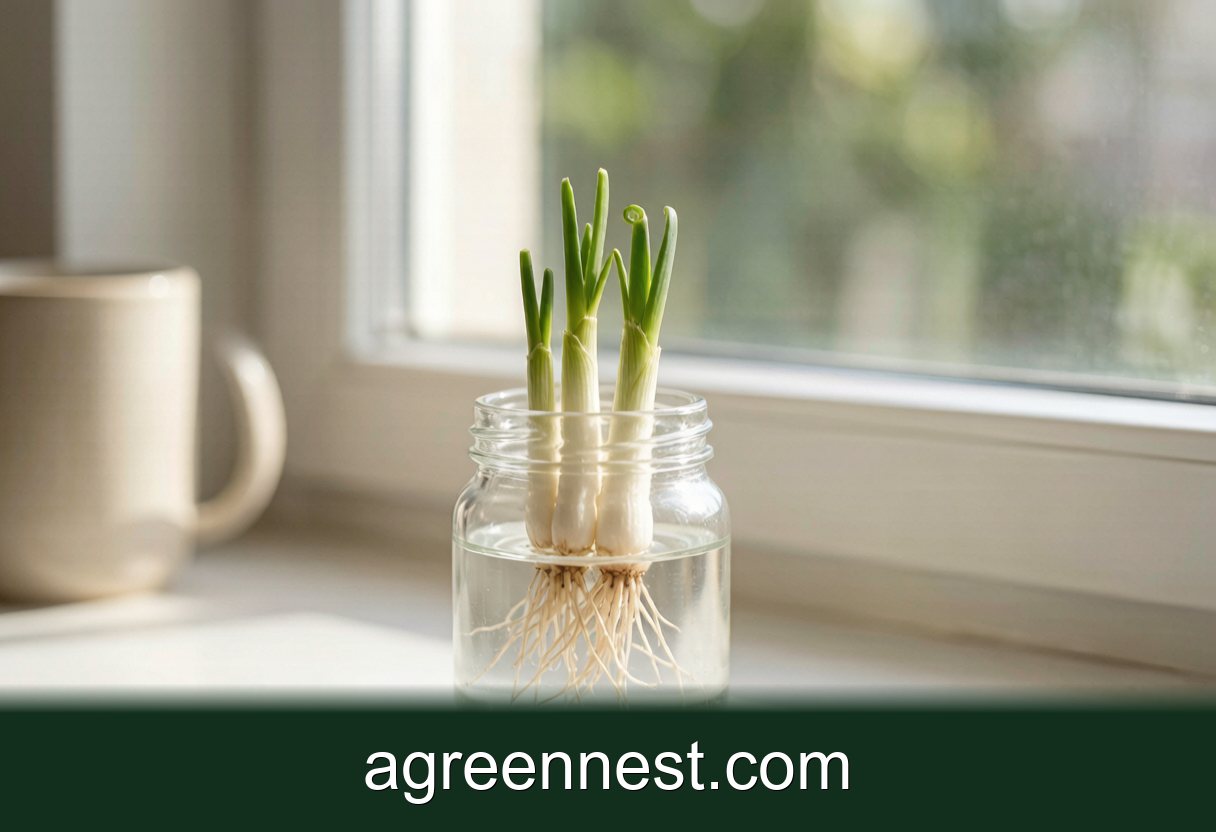
Cut green onions 5 cm above the roots, stand the stubs root-down in 2 to 3 cm of water on a bright windowsill, and change the water every 2 days. You get harvestable green shoots in 7 to 10 days. Plain water supports 2 to 3 cuttings; after that, move the stubs to dilute nutrients or soil.
A bunch of green onions costs about a dollar and most people throw away the part that grows. The white stub with the roots attached is a complete regrowth engine, and it restarts in a glass of water on a windowsill with no equipment at all.
I have run six rounds of stubs through jars on my kitchen sill over the past year, logged what worked, and killed a few batches on purpose to find the failure points. Here is the exact process, plus the two mistakes that end most people's attempts by day five.
What Do You Actually Need to Start?
Three things, and you own all of them already:
- Green onion stubs (Allium fistulosum): cut 5 cm above the root plate. Shorter than 3 cm and the stub runs out of stored energy before new shoots establish; my 2 cm test batch produced shoots half as thick as the 5 cm control.
- A narrow glass or jar: the stubs should lean against the rim and stand upright. A shot glass holds 3 stubs; a small jam jar holds 6 to 8 without crowding.
- A bright windowsill: east or south facing works best. Green onions tolerate less light than most herbs, but below roughly 4 hours of bright daylight the new shoots come up pale and thin.
Fill the glass so the water covers the roots and the bottom 2 to 3 cm of the stub. Not more. Submerging half the stub is the first of the two killer mistakes: the layers above the waterline stay wet, and wet onion layers turn to slime in about four days at room temperature.
The 7-Day Timeline: What Happens When?
This is the part nobody tells you, so you assume something is wrong on day three when nothing visible has happened. Nothing visible is normal. The roots move first.
- Day 1-2: existing roots plump up and new white root tips appear. No shoot movement yet.
- Day 3-4: a green ring rises from the center of the cut surface. It grows from the inside out, which is why you cut flat and clean rather than crushing the stub.
- Day 5-7: the central shoot extends 2 to 5 cm. Growth speeds up noticeably; at 20 to 24°C mine average just over 1 cm per day in this phase.
- Day 7-10: shoots reach 10 to 15 cm and are ready for a first light harvest. Snip what you need with scissors and leave at least 5 cm standing so regrowth continues.
Cooler rooms stretch this timeline. At 16°C my winter batch took 16 days to reach the same height a summer batch hit in 8. The jar-garden approach in our hydroponic jar garden build follows the same temperature math.
Why Does the Water Turn Cloudy and Smell?
Because you skipped a water change, and this is the second killer mistake. The stub sheds sugars and dead outer cells into the water, bacteria feed on both, and by day four in unchanged water you get a cloudy jar with a distinct oniony-sewage note. Roots sitting in that soup suffocate and rot.
The fix is a schedule, not a product. Change the water every 2 days, rinse the roots under the tap for a few seconds, and wipe the slime film off the inside of the glass with your thumb. That 60-second routine is the whole maintenance load. Tap water is fine here; onions are not sensitive the way seedlings are, though if your tap runs very hard the comparison in tap water vs RO for hydroponics explains what the white crust on your jar rim is telling you.
A jar on a sunny sill also grows algae on the glass within a couple of weeks. It is ugly rather than harmful at this scale, but the same shading tricks from preventing algae in hydroponics apply: an opaque cup or a paper sleeve around the glass stops it completely.
How Many Times Can One Stub Regrow?
In plain water: two full harvests, three if you accept thinner shoots. The stub is spending its stored reserves, and water contributes nothing back. My logged rounds came in at 14 g of trimmed greens per stub on the first cutting, 9 g on the second, and 4 g of visibly pale material on the third.
Past that point you have two upgrade paths:
Path 1, dilute hydroponics. Move the stubs to a jar with quarter-strength liquid nutrients, around EC 0.6 to 0.8, and treat it as a passive Kratky setup with the roots half-submerged and an air gap above the waterline. Regrowth quality resets almost to first-cutting level. The full no-pump method is in the Kratky guide.
Path 2, soil. Plant the stubs 2 cm deep in any potting mix on the same windowsill. Slower to restart than water, but the stubs thicken over months and a 15 cm pot of six stubs becomes a permanent cut-and-come-again clump. This is the retirement plan for every batch I run.
Either way, rotate: keep one jar of fresh stubs starting while an older batch finishes. Two jars, offset by a week, cover a household's garnish needs indefinitely. If you like this workflow, the same rolling system scales to a full kitchen herb setup.
Frequently Asked Questions
Q: My green onion stubs went slimy and soft by day 4. What did I do wrong?
A: Almost always one of two things: the water level covered more than the bottom 2 to 3 cm of the stub, or the water sat unchanged for 4 or more days. Cut fresh stubs, keep only the roots plus 2 cm submerged, and change water every 2 days.
Q: The regrown shoots are much thinner and paler than the onions I bought. Is that normal?
A: By the second or third regrowth in plain water, yes. The stub has spent its reserves and water adds none back. Move the stubs to quarter-strength nutrient solution (EC 0.6 to 0.8) or into soil and thickness recovers on the next cutting.
Q: Can I regrow the onion bulbs with the roots cut off that some supermarkets sell?
A: Rarely worth it. Regrowth starts from the root plate, and trimmed-flat bases with no root stubs usually rot before they re-root. Look for bunches with at least 5 mm of visible root fuzz.
Q: Do regrown green onions taste the same as the original bunch?
A: First regrowth in water tastes nearly identical, slightly milder. Later water-only cuttings lose punch along with thickness. Soil-grown or nutrient-fed regrowth keeps full flavor because the plant is not running on empty reserves.
Q: How do I harvest so the stub keeps producing instead of dying?
A: Cut with scissors 5 cm above the base and never pull the shoot out. Removing the growing point at the center kills future regrowth; leaving 5 cm of standing shoot keeps the engine running.
Green onion stubs are the lowest-stakes entry into growing food indoors: zero cost, one glass, results inside a week, and every failure teaches you something a lettuce system charges much more to learn. Start a jar tonight, set a water-change reminder for even-numbered days, and check your tap against our water quality guide if the first batch looks off.
Sources & further reading
GreenNest authors research and write every guide independently. The external links below are reputable references we recommend for deeper reading — they are not the sources we copied from.
- Michigan State University — College of Agriculture & Natural Resources — Michigan State University
- University of Minnesota Extension — U Minnesota Extension
- NC State Extension Plant Toolbox — NC State Extension
Recommended Tools for Hydroponic Growing Care
Free, no-signup helpers matched to this guide.
Free Ebooks to Explore
Downloadable handbooks — no email required.
Free Ebook
The AGreenNest Succulent Care Handbook
The complete, beginner-to-confident guide to growing fat, happy succulents — 10 chapters and a 20-plant directory.
Free Ebook
Haworthia & Haworthiopsis Care Handbook
A focused guide to the striped, forgiving Haworthia clan.
Share Your Plant Story
Grown something tricky, or found a trick that finally worked? Tell us in the comments, or see what other readers are sharing on our Community page. The best reader tips get folded back into our guides.
Join the Conversation
Have a tip or a question about Regrow Green Onions in Water: 7-Day Quickstart? Share it below — comments are saved on our server.