 AGreenNest
Hydroponic Growing
How Long Does Mixed Hydroponic Nutrient Last?
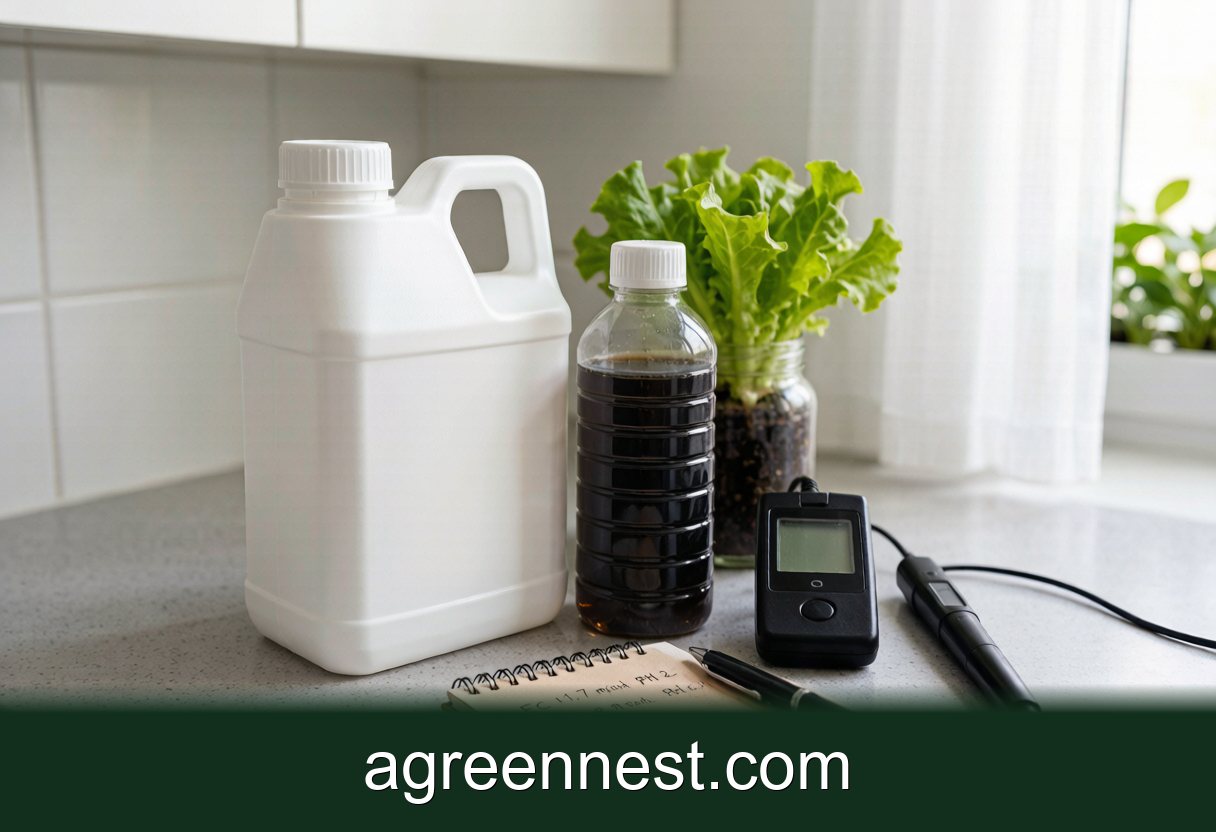
Premixed hydroponic nutrient solution keeps 7 to 10 days in a sealed, opaque container stored cool and dark. In my 14-day test, EC held within 0.05 but pH crept from 5.9 to 6.2, so re-check pH before each use. Clear bottles in daylight grew algae by day 8. Organic nutrients spoil in about 3 days.
A reader emailed me a fair question: "Can I mix a week of nutrient solution on Sunday, or does it go bad in the jug?" I realised I had been repeating the standard advice, mix fresh every time, without ever checking whether it holds up. So I ran the test.
Four litres per batch, same two-part synthetic nutrient, starting at 1.6 EC and pH 5.9. Three storage setups, 14 days, and an EC/pH reading every other morning. One batch of fish-based organic nutrient as a control, because someone always asks.
Short version: the standard advice is too cautious for synthetic nutrients and not cautious enough for organic ones.
The Test Setup
Nothing exotic here. Tap water left out overnight to shed chlorine (my tap runs about 0.3 EC baseline; if yours is harder, the tap versus RO comparison covers when that matters). Nutrient A and B mixed in the usual order, A fully stirred before B goes in, never the concentrates together.
The three storage conditions:
- Opaque 4 L HDPE jug, capped, in a cupboard. Steady 21 to 22 °C, zero light.
- Clear 4 L PET bottle on a windowsill. East-facing, roughly 3 hours of direct morning sun.
- Open 4 L bucket with the lid resting ajar. Same cupboard as the jug, so temperature stayed equal and only air exposure differed.
I calibrated the EC meter with 1.41 mS/cm solution and the pH pen with 4.0 and 7.0 buffers before starting. If you skip calibration, none of your numbers mean anything.
What Happened Over 14 Days
The opaque cupboard jug was the clear winner. EC read 1.60 on day 0 and 1.62 on day 14, within meter error. pH drifted from 5.9 to 6.1 by day 7 and 6.2 by day 14. No smell, no cloudiness, no film on the walls. Shaken and pH-corrected, this batch was still perfectly usable at the two-week mark.
The windowsill bottle failed on schedule. Readings looked fine through day 6, then a faint green haze appeared on the sunlit wall by day 8, and by day 12 the bottle had a visible algae film and pH had climbed to 6.6. Light plus dissolved nitrogen equals algae; the same reason clear reservoirs cause trouble, which the algae prevention guide goes into.
The open bucket concentrated itself. No algae in the dark cupboard, but evaporation pulled roughly 350 ml out over two weeks and pushed EC from 1.60 to 1.85. Feed that to seedlings expecting 1.0 and you burn roots without ever mismixing.
The organic control was done by day 3. Cloudy on day 3, sour-smelling by day 5, capped jug or not. Microbes eat fish-based nutrients whether or not you invite them.
Why Does pH Creep Up in Storage?
The drift from 5.9 to 6.2 is not spoilage. Freshly mixed solution absorbs carbon dioxide from the air until it reaches equilibrium, and dissolved CO2 chemistry nudges the reading around during the first day or two. On top of that, some ammonium-to-nitrate conversion continues slowly in the jug.
A 0.3 rise over two weeks is nothing to panic about. It is, though, a solid reason to re-check pH right before the solution goes anywhere near roots, rather than trusting the number you dialled in on mixing day. My working range is 5.5 to 6.5, with 5.8 to 6.2 as the target; the pH management guide has the full correction routine.
Can You Store the Concentrates Instead?
Yes, and honestly this is the better default. Undiluted A and B bottles keep for a year or more sealed in a cool cupboard, because their salt concentration is too high for anything to grow in.
The problems only start after dilution. So for a small Kratky jar or a countertop unit, mixing 2 L fresh takes four minutes and skips the storage question entirely. Premixing earns its keep when you run several reservoirs on the same recipe, or when someone less hydro-literate tops up your system while you travel.
Never, under any circumstances, store A and B mixed together at concentrate strength. Calcium from one part locks up with sulfates and phosphates from the other, and the white sediment at the bottom of the jug is fertiliser your plants will never see.
My Storage Rules After the Test
- Synthetic nutrient, opaque sealed container, cool and dark: use within 7 to 10 days. It survived 14 in my test, but that margin covers a warmer cupboard than mine.
- Shake the jug before every pour. Some salts settle within days.
- Re-check pH at each use; correct if it has wandered past 6.3.
- Clear containers are fine only if they live inside a closed cabinet. Any daylight, switch to opaque or wrap the bottle in aluminium foil.
- Organic nutrients: mix only what the plants drink that day. Three days is the outer limit, and it smells like a penalty.
- Label the jug with mix date and EC. Future you will not remember.
One more note: stored solution is not a substitute for changing the reservoir itself. Plants shift the nutrient balance as they feed, so the reservoir still needs its regular refresh on the schedule in the solution change guide.
Frequently Asked Questions
Q: My premixed jug has white powder on the bottom. Is the batch ruined?
A: Partly. That sediment is precipitated calcium salts that will not redissolve with shaking. The liquid above still works, but its calcium content is lower than the label maths says. Use it on tolerant leafy greens, not fruiting plants, and mix a shorter-lived batch next time.
Q: Can I refrigerate mixed nutrient solution to make it last longer?
A: You can, and it slows both microbial growth and pH drift. The catch is temperature shock; solution at 5 °C poured onto roots living at 20 °C stalls them. Let the jug stand at room temperature for a few hours first.
Q: Does the 7-to-10-day rule change in summer heat?
A: Yes. At 28 to 30 °C cupboard temperatures, halve it. Warmth speeds up every reaction in the jug, including the ones you do not want.
Q: My stored solution reads a higher EC than when I mixed it. Did the nutrients get stronger?
A: No new nutrient appeared; water left. Evaporation from a loose lid concentrates what remains, exactly like my open-bucket batch drifting from 1.60 to 1.85. Top the jug back to its original volume with plain water and the EC returns to target.
Q: Is a milk jug safe for storing nutrient solution?
A: A well-rinsed HDPE milk jug works, and its opacity is actually ideal. Rinse until no protein residue remains, since milk traces feed bacteria. I still prefer a dedicated jug so nobody in the house makes an unfortunate drink choice.
Mix-ahead is a real convenience, and with synthetic nutrients in an opaque jug it is a safe one for a week or more. The two habits that make it work are a shake before pouring and a 30-second pH check. If you want to dial in the starting numbers for your particular crop before you batch anything, our free fertilizer calculator does the arithmetic for you.
Sources & further reading
GreenNest authors research and write every guide independently. The external links below are reputable references we recommend for deeper reading — they are not the sources we copied from.
- Michigan State University — College of Agriculture & Natural Resources — Michigan State University
- NC State Extension Plant Toolbox — NC State Extension
- University of Minnesota Extension — U Minnesota Extension
Recommended Tools for Hydroponic Growing Care
Free, no-signup helpers matched to this guide.
Free Ebooks to Explore
Downloadable handbooks — no email required.
Free Ebook
The AGreenNest Succulent Care Handbook
The complete, beginner-to-confident guide to growing fat, happy succulents — 10 chapters and a 20-plant directory.
Free Ebook
Haworthia & Haworthiopsis Care Handbook
A focused guide to the striped, forgiving Haworthia clan.
Share Your Plant Story
Grown something tricky, or found a trick that finally worked? Tell us in the comments, or see what other readers are sharing on our Community page. The best reader tips get folded back into our guides.
Join the Conversation
Have a tip or a question about How Long Does Mixed Hydroponic Nutrient Last?? Share it below — comments are saved on our server.