 AGreenNest
Plant Pests & Diseases
Yellow vs Blue Sticky Traps: I Counted for 6 Weeks
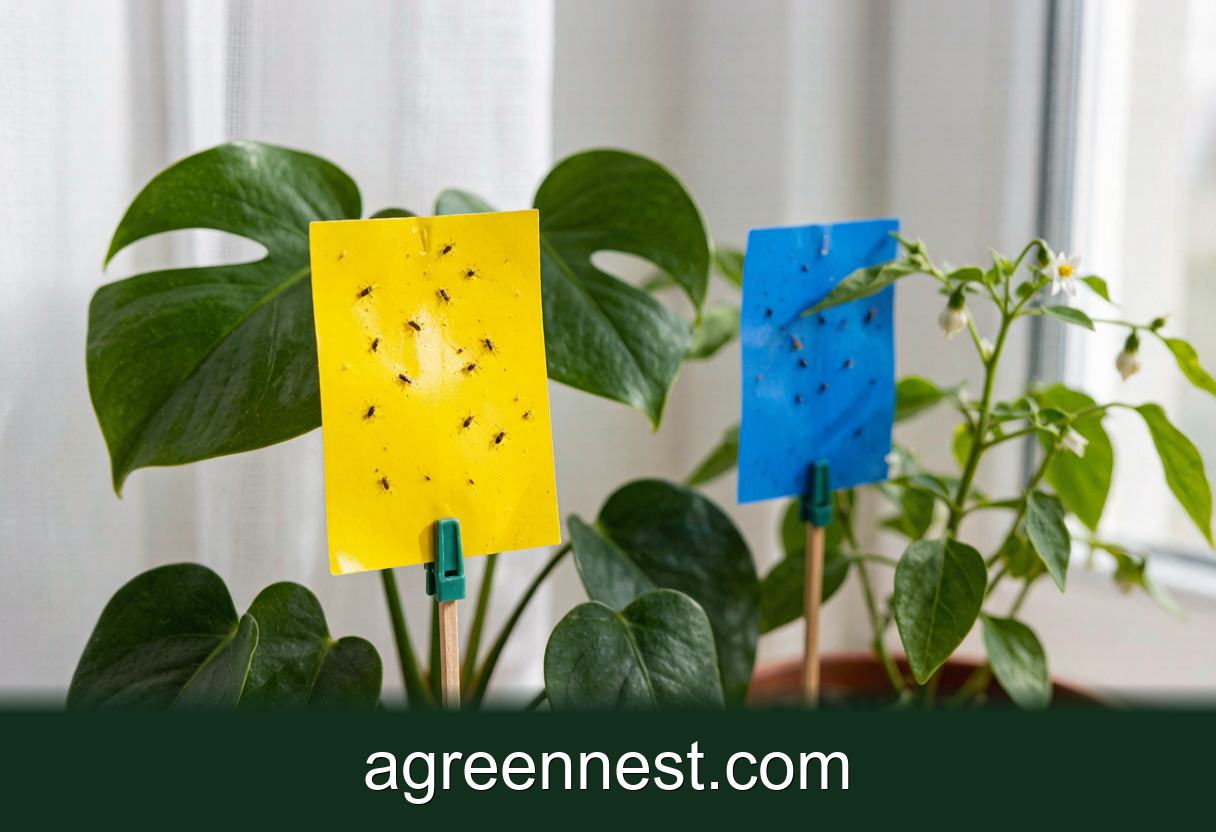
Color matters more than most trap instructions admit. In my six-week count, yellow cards caught roughly four times more fungus gnats and whiteflies than blue, while blue edged ahead for western flower thrips. Buy yellow by default; add blue only when you have confirmed thrips on the leaves.
The trap packet in my drawer says "attracts all flying plant pests." That claim bothered me, because the greenhouse literature says flying insects are picky about color: some species steer toward yellow-green wavelengths around 550nm, others toward blue near 440nm. One card cannot be optimal for both.
So I ran the obvious test. Twelve pots, six weeks, one yellow and one blue card per pot at identical heights, counted and swapped every Monday. My flat hosted three pest populations that winter, which was miserable for the plants and perfect for the experiment.
How I Set Up the Count
The twelve pots split into three groups with confirmed, established pests. Four pots of Epipremnum aureum and Spathiphyllum wallisii carried fungus gnats (Bradysia species). Four chilli and Monstera deliciosa pots had western flower thrips (Frankliniella occidentalis), confirmed by the silvery scars and black speck droppings on leaves. Four assorted pots near the balcony door held greenhouse whiteflies (Trialeurodes vaporariorum).
Each pot got one 7x10cm yellow card and one blue card of the same brand and glue type, clipped 5cm above the soil line on opposite sides of the pot, swapped side-to-side weekly so position could not bias the result. Every Monday I photographed both cards, counted with a loupe, and replaced them.
Six weeks, 144 card-counts. Not a peer-reviewed trial, one apartment, one winter. But the gaps were not close.
Which Color Caught More Fungus Gnats?
Yellow. It was not remotely a contest.
Across four pots and six weeks, the yellow cards logged 412 fungus gnat adults. The blue cards over the same pots and weeks: 96. That is better than a 4:1 margin, and it held every single week; the worst week for yellow was still double the best week for blue.
This tracks with how gnats find food. Adults orient toward the yellow-green reflectance of stressed plants and algae-crusted wet soil. Blue means nothing to them. If gnats are your problem, yellow cards near the soil surface plus the drying-out routine in our fungus gnat elimination guide does more than any spray I have tested. Remember the cards only remove adults; the larvae in the top 3 to 5cm of soil are the actual infestation, a point our trap comparison goes into with counts of its own.
Do Blue Traps Actually Win for Thrips?
Yes, but by less than the marketing suggests.
The thrips pots gave blue its only victory: 187 adult thrips on blue cards against 133 on yellow over six weeks, roughly a 40 percent edge. Real, repeatable, and consistent with greenhouse studies that put Frankliniella occidentalis preference near 440nm blue. But notice that yellow still caught plenty. A yellow card will absolutely tell you thrips are present; blue just tells you a little sooner and in bigger numbers.
There is one more wrinkle: counting tiny cigar-shaped thrips on a blue card is easier on the eyes than on yellow, where they vanish against the glue shine. For monitoring, that visibility difference matters almost as much as the catch rate.
Whiteflies, and the Card Position Trap
Whiteflies went to yellow even harder than the gnats did: 240 adults on yellow, 41 on blue. No surprise, since commercial greenhouses have used yellow for whitefly monitoring for decades.
But my first two weeks of whitefly counts were nearly zero on both colors, and the reason was placement. I had clipped the cards 5cm above the soil, where gnats fly. Whiteflies live on the undersides of upper leaves and flit between plants at canopy height. Once I raised those cards level with the top leaves in week three, the catches jumped tenfold. Card height matters as much as card color: soil level for gnats, canopy level for whiteflies and thrips. If you are not sure which pest you have, the ID walk-through in identifying plant pests early sorts the lookalikes before you spend on traps.
What Sticky Traps Cannot Do
Traps are a census, not a cure. Six weeks of heavy trapping reduced my gnat annoyance, but the larvae kept pupating until I fixed the watering. The thrips kept scarring new Monstera leaves because the larval stages never fly at all, and the whitefly nymphs sat immobile under leaves the whole time, untouched by any card.
Treat the counts as your dashboard. Rising numbers week over week mean your actual control, whether that is soil drying, insecticidal soap, or predatory mites, is not working. Falling numbers mean it is. That feedback loop is worth more than the direct kill. New arrivals are still the cheapest pests to stop, which is why every plant that enters my flat spends two weeks in quarantine with one yellow card of its own.
The Verdict, and What I Buy Now
Buy yellow by default. It won two of three pest groups by 4:1 or better, and it detects thrips well enough to raise the alarm. Add blue cards only after you have confirmed thrips, and hang them at canopy height where the adults cruise. My standing setup is now one yellow card per pot at soil level from October to March, plus blue cards at leaf height on the thrips-prone chillies and Monstera.
A packet of 20 dual-color cards costs $8 to $12, which for six months of pest monitoring is the best money in this hobby.
Frequently Asked Questions
Q: My yellow trap is covered in gnats after a week. Does that mean the traps are working?
A: It means the traps are counting, not curing. Each stuck adult laid eggs before it landed. Pair the cards with letting the top 3 to 5cm of soil dry between waterings, or the counts will stay flat for months.
Q: Do sticky traps catch fungus gnat larvae in the soil?
A: No. Cards only intercept flying adults. Larvae stay in the moist upper soil until they pupate, which is why drenches and drying target them and cards never will.
Q: Will yellow cards trap my ladybugs and other helpers?
A: They can. Yellow is attractive to some beneficial insects, including hoverflies and parasitic wasps. Indoors this rarely matters, but if you release beneficials on purpose, pull the cards for two weeks afterward.
Q: How often should the cards be replaced if they are not full?
A: Every three to four weeks even when half-empty. Household dust dries the adhesive layer, and a card that has lost its tack under-reports the infestation just when you trust it most.
Q: Are blue traps ever worth it for fungus gnats?
A: On my counts, no. Blue caught fewer than a quarter of what yellow did in every gnat week. Save blue for confirmed thrips at canopy height.
One packet claim, six weeks of counting, and a clear answer: color is a targeting decision, not a decoration. Yellow for gnats and whiteflies at the heights they fly, blue as a thrips specialist, and neither as a standalone cure. If you spot something on a card you cannot name, run it through our pest identifier tool before you reach for a spray.
Sources & further reading
GreenNest authors research and write every guide independently. The external links below are reputable references we recommend for deeper reading — they are not the sources we copied from.
- US EPA — Safer Pest Control — US EPA
- NC State Extension — Plant Toolbox — NC State Extension
Recommended Tools for Plant Pests & Diseases Care
Free, no-signup helpers matched to this guide.
🔍 Free Tool
Pest & Problem Identifier
Pick the symptoms you see and get the likely culprit plus a fix.
Free Ebooks to Explore
Downloadable handbooks — no email required.
Free Ebook
The AGreenNest Succulent Care Handbook
The complete, beginner-to-confident guide to growing fat, happy succulents — 10 chapters and a 20-plant directory.
Free Ebook
Haworthia & Haworthiopsis Care Handbook
A focused guide to the striped, forgiving Haworthia clan.
Share Your Plant Story
Grown something tricky, or found a trick that finally worked? Tell us in the comments, or see what other readers are sharing on our Community page. The best reader tips get folded back into our guides.
Join the Conversation
Have a tip or a question about Yellow vs Blue Sticky Traps: I Counted for 6 Weeks? Share it below — comments are saved on our server.