 AGreenNest
DIY Plant Projects
Build a Water Propagation Jar Garden in 30 Minutes
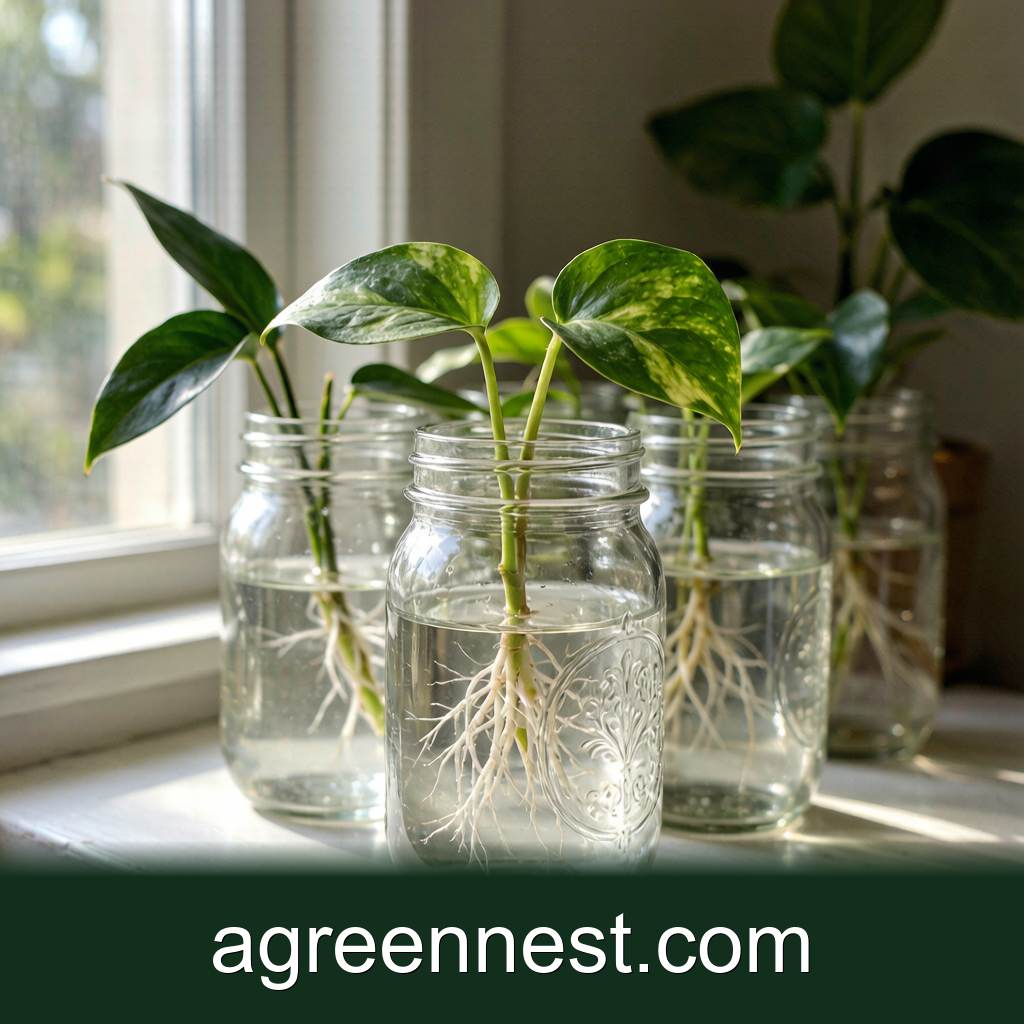
A water propagation jar garden lets you root cuttings in glass jars with nothing but water, light, and a sharp pair of scissors. Choose narrow-neck jars so leaves stay dry, change the water every 5 to 7 days, and place the jars in bright indirect light. Roots appear in 2 to 4 weeks for most common houseplants, at which point you can pot them up or keep them growing in water indefinitely.
A water propagation jar is the fastest path from a single stem to a full plant, no soil, no mess, and no special tools. You need a glass jar, clean water, and a cutting from a plant you already own. This guide puts a full jar garden on a shelf in under half an hour and tells you exactly when to pot up each rooted stem. Skip the propagation station if you want less gear and more speed, because a row of jars on a windowsill works the same way and costs next to nothing.
Pick the Right Jars
Glass jars with a narrow opening, think pasta-sauce jars, apothecary bottles, or small bud vases, hold the cutting upright and keep most of the leaf above the waterline. Wide-mouth jars let the leaf flop in, which rots the tissue within days, so choose a neck that acts as a brace. The jar should be clear glass so you can watch root growth without pulling the cutting out. Reuse any food-safe jar after a hot wash and a rinse, and at 10 to 15 cm tall, about 4 to 6 inches, most kitchen jars are already the right size. Dark glass works too but hides root rot early, so stick with clear unless you check every day. Aim for one jar per cutting so the roots never tangle, and a group of three to six in a row looks like a clean mini-lab on a shelf.
Which Plants Root Fastest in Water?
Plants with a visible node, the little bump on the stem where a leaf or aerial root grew, root in water faster than woody stems. Pothos (Epipremnum aureum) roots in 10 to 14 days and is the beginner pick. Heartleaf Philodendron (Philodendron hederaceum) follows close at 14 to 20 days. Spider plant babies (Chlorophytum comosum) arrive with tiny root nubs and grab water within a week. Tradescantia (Tradescantia zebrina) roots in under a week, and Monstera adansonii sends out strong white roots in 3 to 4 weeks. Most pothos varieties and philodendrons handle water indefinitely, so you never have to pot them up if you like the glass-jar look. Skip succulents, snake plants, and ZZ plants, because their thick storage leaves and rhizomes rot in standing water long before roots sprout.
How to Take the Cutting
Cut just below a node with a clean pair of scissors or a razor blade, since a crushed stem at the cut blocks water uptake. Aim for a stem 10 to 15 cm long with at least 2 or 3 leaves and one bare node section at the bottom. Remove any leaf that would sit below the waterline, because submerged leaves break down fast and cloud the water with bacteria. Let the cut stem sit on a paper towel for 20 to 30 minutes so the wound calluses slightly before it hits the water, because a fresh-wet cut is a highway for rot fungi. This step is extra useful if the room runs above 24°C (75°F). The callus step matters more for thick-stem plants like Monstera, less for thin pothos, but it never hurts. Take an extra cutting as backup, because one out of four will stall and fail for no clear reason.
Set Up the Jar Garden
Fill each jar with room-temperature tap water or rainwater, not cold fridge water, and set the water level so 2 to 3 cm of bare stem sit submerged with at least one node underwater and every leaf above the rim. Place the jars in bright indirect light, 60 to 120 cm from a south or east window, where the glass won't overheat. Direct afternoon sun heats the water enough to cook the roots, so a sheer curtain in that window solves the problem in seconds. A shelf, a windowsill, or even a set of wall-mounted brackets all work, and the propagation station guide shows how to turn a windowsill into a full setup. Keep the room above 18°C (65°F), because cold water stops root growth cold. The glass acts as a tiny greenhouse near a warm window, and that gentle heat inside the jar nudges roots along faster than open air.
Water Changes and Weekly Care
Change the water every 5 to 7 days, not when it looks murky, but on a schedule, because stale water loses dissolved oxygen and bacteria multiply fast even in clear-looking jars. Pour out the old water and rinse the inside gently, then refill with room-temperature water, and never use softened water, because the added sodium salts slow root growth to a crawl. If a white film or a few strands of algae appear on the glass, rub it off with a bottle brush or a paper towel twisted around a chopstick, and the next change will stay clear longer. Roots want oxygen, so never fill the jar to the brim. Leave at least 2 to 3 cm of air between the water surface and the top of the stem, because that air layer is where oxygen dissolves in from above. A drop of liquid houseplant fertilizer once a month, at quarter strength, keeps rooted cuttings green and fed if you plan to leave them in the jar for months, but skip the feed until roots are at least 3 cm long.
When to Pot Up Versus Keep in Water
Roots at 5 to 8 cm long, roughly 2 to 3 inches, with visible side branches signal the cutting is ready for soil. Pot the rooted cutting into a small 8 to 10 cm pot with standard indoor potting mix, water it in well, and keep the soil moist but not soggy for the first two weeks, because water-grown roots are soft and need a transition period. Bag the pot loosely with a clear plastic bag for the first week to hold humidity high while the roots adjust to soil, then remove it slowly over a few days. Many growers keep the plant in water forever, because pothos and philodendron thrive in water alone as long as the water changes stay regular. A clear glass jar full of green roots is a design feature, not a step to skip, and fits the small-space plant styling look cleanly.
Frequently Asked Questions
Q: Why are my cuttings rotting instead of rooting?
A: The stem is sitting too deep, a leaf is underwater, or the water is too cold. Snip a fresh cutting above the rot, drop the water level so only bare stem is submerged, and use room-temperature water. Change it every 5 days and move the jar out of direct sun.
Q: Can I put multiple cuttings in one jar?
A: One cutting per jar works better, because crowded stems share bacteria and tangling roots snap when you separate them later. If you want a bushy jar, pick a wider opening and change the water twice a week to keep oxygen levels up.
Q: Do water propagation jars need fertilizer?
A: Not until roots are at least 3 cm long. After that a single drop of quarter-strength liquid houseplant feed at each water change is enough. Overfeeding in water grows algae faster than roots, so less is safer.
Q: Why did my cutting wilt the first day?
A: A fresh cutting loses water through its leaves with no roots to pull more in. Move the jar away from direct light for 48 hours, keep the room humid, and the leaves should perk up soon. If the stem is still firm at the node, patience is the fix.
Q: Can I move water-rooted cuttings directly into soil?
A: Yes, once roots are 5 to 8 cm long. Keep the soil moist and bag the pot for the first week to bridge the humidity gap, because water-grown roots have no cuticle and dry out fast in open air. Remove the bag gradually over 3 to 4 days to avoid shock.
A line of glass jars on a shelf costs almost nothing and turns surplus cuttings into free plants. Start with a stem from the pothos you already own, because pothos roots in water with near certainty. The kokedama guide turns that rooted cutting into a moss ball later, and the hydroponic jar garden is the natural next step if you want to keep everything in water forever. One jar, one cutting, one window, that is all it takes.
Sources & further reading
GreenNest authors research and write every guide independently. The external links below are reputable references we recommend for deeper reading — they are not the sources we copied from.
Recommended Tools for DIY Plant Projects Care
Free, no-signup helpers matched to this guide.
Free Ebooks to Explore
Downloadable handbooks — no email required.
Free Ebook
The AGreenNest Succulent Care Handbook
The complete, beginner-to-confident guide to growing fat, happy succulents — 10 chapters and a 20-plant directory.
Free Ebook
Haworthia & Haworthiopsis Care Handbook
A focused guide to the striped, forgiving Haworthia clan.
Share Your Plant Story
Grown something tricky, or found a trick that finally worked? Tell us in the comments, or see what other readers are sharing on our Community page. The best reader tips get folded back into our guides.
Join the Conversation
Have a tip or a question about Build a Water Propagation Jar Garden in 30 Minutes? Share it below — comments are saved on our server.