 AGreenNest
Plant Pests & Diseases
Rescue a Hoya From Mealybugs: My 6-Week Plan
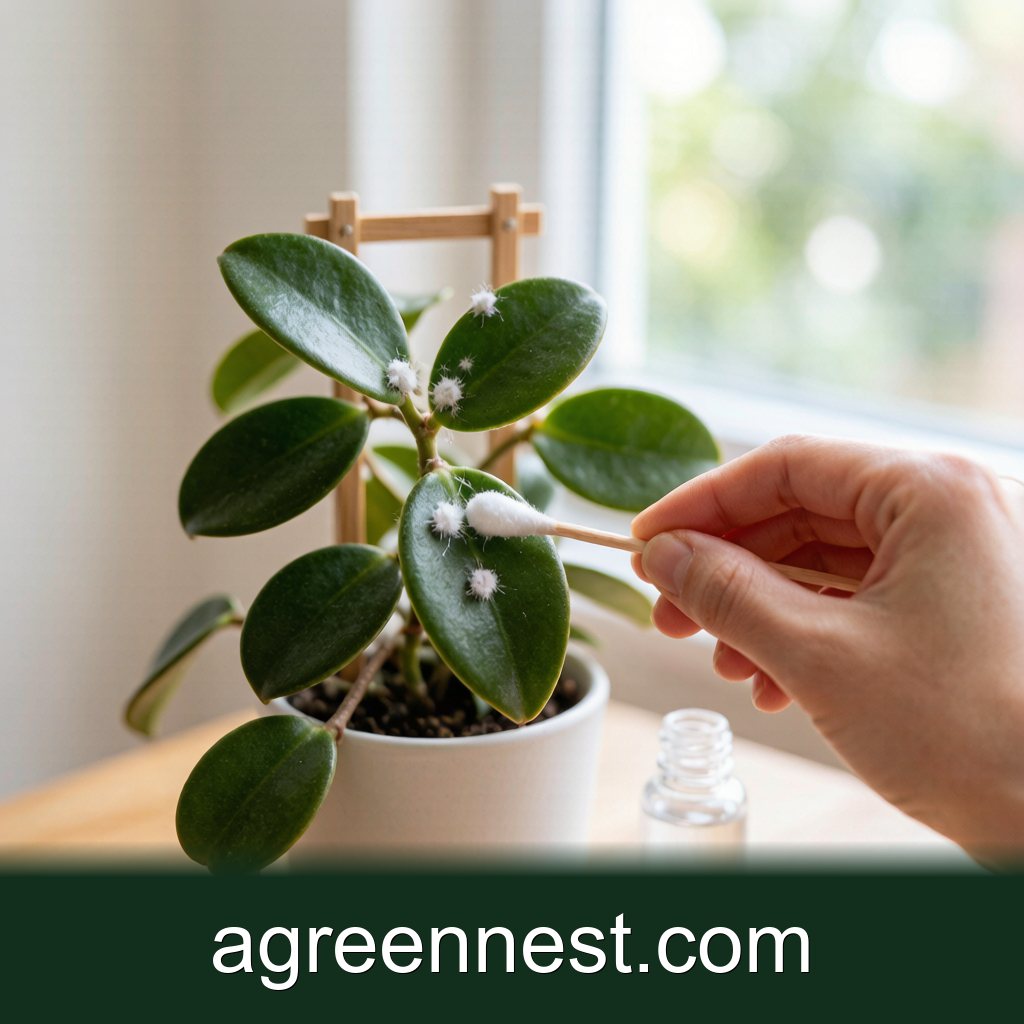
Mealybugs hide in hoya leaf axils, under flower spurs, and inside curled new growth, so a single spray misses most of them. Dab every visible bug with 70% isopropyl alcohol, repeat weekly for six weeks to outlast the 7-10 day hatch cycle, and inspect the root ball. Badly covered vines are often better restarted from clean cuttings.
The white fluff on my Hoya carnosa looked like dust from a shelf above it. I wiped it off, felt pleased, and moved on. Ten days later the fluff was back, and this time it moved. Under a hand lens each speck was an oval, powdery insect about 3 mm long, wedged so deep into the leaf axil that a cotton pad could not reach it.
That plant took six weeks to clean up, and I made most of the classic mistakes. Here is the rescue plan I wish I had started with, tested on that vine and two more since.
Why Do Mealybugs Love Hoyas So Much?
Three reasons, and they stack.
First, geometry. A hoya vine is a maze of tight leaf axils, twining stems, and the little woody flower spurs (peduncles) that persist year after year. Citrus mealybugs (Planococcus citri) tuck into exactly these crevices, where contact sprays never land. Second, the thick waxy leaves of Hoya carnosa and Hoya australis tolerate the sap loss for months, so an infestation builds quietly. Third, hoya flowers drip sugary nectar, and the honeydew mealybugs excrete looks similar enough that many owners shrug it off. If your leaves are tacky with no blooms in sight, treat it as evidence; sticky leaves almost always mean sap-feeding pests.
By the time you spot cottony masses, assume three generations are present: adults, crawlers, and eggs hidden in that white wax. A female lays 300 to 600 eggs, and at 24 °C they hatch in roughly 7 to 10 days. That number drives the whole schedule below.
Week 1: Isolate, Prune, and Swab
Move the hoya at least 2 metres from every other plant, ideally to another room. Mealybug crawlers are slow but they do walk, and I have watched an infestation jump from a hoya to a neighbouring pothos across touching leaves.
Then work through the vine section by section:
- Prune the worst. Any growth tip that looks like it has been dipped in cotton wool gets cut off and binned in a sealed bag, not composted. Hoyas resprout from bare nodes, so be braver than feels comfortable.
- Swab what remains. Dip a cotton bud in 70% isopropyl alcohol and touch every visible bug. The wax dissolves on contact and the insect dies within seconds. On my carnosa the first session took 40 minutes and I counted 63 bugs. Keep the alcohol off the plant in bulk; spot application is safe on waxy hoya leaves, but I test one leaf and wait 48 hours on thin-leaved species like Hoya bella. The full technique, including dilution questions, is in our rubbing alcohol vs mealybugs test.
- Check the peduncles. Do not snip the flower spurs, hoyas rebloom from the same ones, but swab around their bases carefully. In my counts, roughly a third of all adults sat within 1 cm of a spur.
Weeks 2-6: Break the Hatch Cycle
This is where most rescues fail. One thorough session feels like victory, but the eggs you missed hatch on schedule, and two weeks later the plant looks as bad as when you started.
Set a recurring reminder and re-inspect every 5 to 7 days for six weeks. Each session: hand lens on axils, spur bases, the undersides of the newest leaves, and the curled, unopened growth tips. Swab whatever you find. Sessions get shorter fast; my week-three pass took eight minutes, week five took two.
Between swab days, a proper spray adds pressure. Insecticidal soap covers crawlers before they settle, and neem oil has some effect on the juveniles that survive it. Spray in the evening, coat the undersides, and repeat weekly at label rates; the neem application guide covers mixing and timing. The EPA's safer pest control pages make the same point I will: a persistent mechanical routine beats escalating to harsher chemicals indoors.
Two rules kept me honest. Never skip a session because the plant "looks clean"; eggs are invisible at arm's length. And never end the isolation early. Zero sightings across the final two weeks is the release condition, the same standard I apply when I quarantine any new plant.
Should You Check the Roots Too?
Yes, and almost nobody does. Root mealybugs are a separate problem, but ordinary citrus mealybugs also retreat below the soil line on hoyas, clustering on the stem base and the top 2 cm of the root ball where it is dark and humid.
Slide the plant out of its pot. White, powdery deposits on the root ball or blue-grey wax on the stem base mean the infestation extends underground. Wash the old mix off, swab the stem base with alcohol, and repot into fresh, dry mix in a cleaned pot. Deposits on the roots themselves point to the subterranean species instead, and the root mealybug protocol is a different, longer fight.
When a Cutting Beats the Cure
Here is the verdict I reached with my third infested hoya, a small Hoya australis where the wax had reached every single axil: I stopped treating it.
Instead I took the four cleanest tip cuttings, swabbed each one twice under a lens, rinsed them, and rooted them in water in a separate room. Hoya cuttings root in 3 to 5 weeks, and every one came up clean. The mother plant went in the bin. Total time invested: under an hour, against the six weekly sessions the full rescue costs.
The maths favours a restart whenever the plant is small, the coverage heavy, or the vine a fussy thin-leaved type. A mature carnosa with woody spurs earns the six-week plan. A 12 cm rooted cutting in its second year usually does not.
Frequently Asked Questions
Q: The white fluff on my hoya rubs off and does not move. Mealybugs or something else?
A: Location tells you. Fuzz in the axils that returns after wiping is nearly always mealybug wax or egg masses, which look like tangled cotton threads under a lens. Uniform residue across the whole leaf after misting is more likely hard-water deposit. When in doubt, our pest identifier walks through the marks.
Q: Can I just hose the whole vine down in the shower instead of swabbing?
A: A firm shower knocks off crawlers and some adults and is a decent opener, but water does not penetrate the wax on egg masses or reach into closed axils. On my first attempt, a shower alone reduced visible adults by about half, and the population fully recovered in under three weeks. Use it as step zero, not the plan.
Q: Mealybugs keep reappearing on the same growth tip every few weeks. Where are they coming from?
A: Three usual sources: eggs inside the curled, unopened leaves at that tip; a colony below the soil line reinfesting upward; or ants farming the bugs for honeydew and carrying crawlers around. Inspect the newest growth, pull the pot to check the stem base, and watch for ant traffic.
Q: Will alcohol swabs damage the silvery splash pattern on my Hoya pubicalyx?
A: No. The splash sits in the leaf tissue, not on the surface, so spot swabs cannot remove it. Heavy wiping can strip the thin bluish bloom on new leaves, which is cosmetic, so swab bugs precisely rather than polishing whole leaves.
Q: My hoya flowered during treatment. Keep the flowers or cut them?
A: Cut them, reluctantly. Open hoya blooms drip real nectar, which feeds the exact pest you are fighting and makes honeydew spotting impossible. The peduncle stays on the vine and reblooms next round, so you lose one flush, not the future ones.
A mealybug rescue on a hoya is not one dramatic treatment, it is a calendar: six short, boring, weekly sessions that outlast the egg bank. Put the reminders in your phone before you put the plant back on its shelf. And if you want to catch the next outbreak at bug number three instead of bug sixty-three, our general mealybug guide covers the early-warning signs across all your plants.
Sources & further reading
GreenNest authors research and write every guide independently. The external links below are reputable references we recommend for deeper reading — they are not the sources we copied from.
- US EPA — Safer Pest Control — US EPA
- NC State Extension Plant Toolbox — NC State Extension
Recommended Tools for Plant Pests & Diseases Care
Free, no-signup helpers matched to this guide.
🔍 Free Tool
Pest & Problem Identifier
Pick the symptoms you see and get the likely culprit plus a fix.
Free Ebooks to Explore
Downloadable handbooks — no email required.
Free Ebook
The AGreenNest Succulent Care Handbook
The complete, beginner-to-confident guide to growing fat, happy succulents — 10 chapters and a 20-plant directory.
Free Ebook
Haworthia & Haworthiopsis Care Handbook
A focused guide to the striped, forgiving Haworthia clan.
Share Your Plant Story
Grown something tricky, or found a trick that finally worked? Tell us in the comments, or see what other readers are sharing on our Community page. The best reader tips get folded back into our guides.
Join the Conversation
Have a tip or a question about Rescue a Hoya From Mealybugs: My 6-Week Plan? Share it below — comments are saved on our server.