 AGreenNest
Plant Care Accessories
Fabric Pots vs Plastic Pots for Houseplants
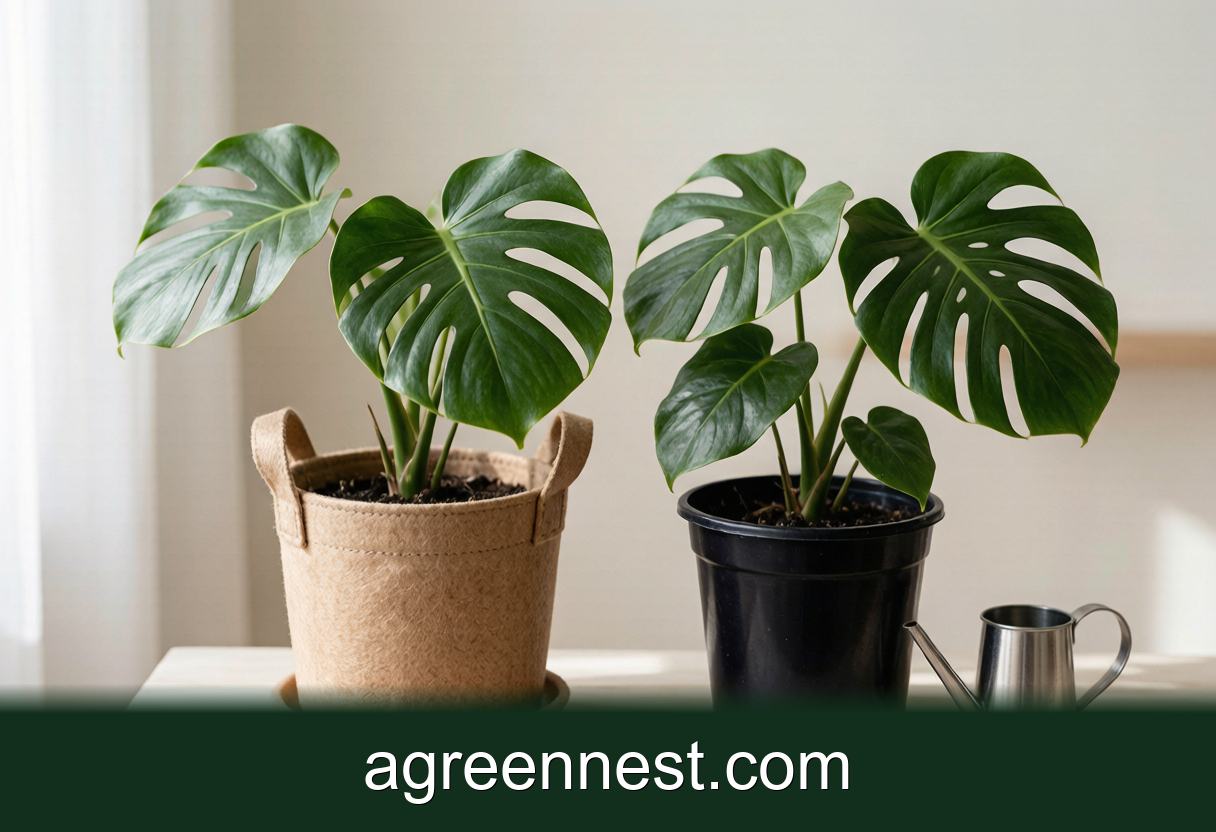
Fabric pots air-prune roots and drain fast, but indoors they dry roughly three times quicker than plastic and wick moisture onto furniture. Use fabric for containers above 15 litres and for chronic overwaterers. Use plastic for anything under 20 cm, for succulents, and inside decorative cachepots.
Two 20 cm pots on the same bench. Same coir and perlite mix, same 22 °C room at 48 percent humidity, same 1.2 litres of water poured in on a Monday morning. By the following Monday the fabric pot had shed 610 g. The plastic pot had shed 205 g.
That gap is the entire argument, and most fabric-pot marketing skips straight past it to talk about root health. Root health is real. So is refilling a watering can three times a week in August.
What Actually Differs Between Fabric and Plastic Pots?
One is a wall. The other is a sieve.
A plastic nursery pot is a solid, non-porous shell with four to eight drainage holes at the base. Water leaves through those holes or through the soil surface, nowhere else.
A fabric pot is non-woven polypropylene felt, usually 200 to 300 gsm, so the entire side wall is a drainage and evaporation surface. On a 20 cm round pot that is roughly 1,100 square centimetres of breathable wall against about 315 square centimetres of open soil at the top. Air reaches the root ball from every direction.
That single structural difference drives everything else: drying speed, root shape, weight, and how the pot behaves on your floor.
How Much Faster Does a Fabric Pot Dry Out?
In my kitchen-scale runs, about three times faster in the first week, then the gap narrows as the fabric pot approaches genuinely dry.
Percentage of applied water lost by day 7, both pots planted with a rooted Monstera deliciosa cutting:
- Plastic, 20 cm: 17 percent
- Fabric, 20 litre equivalent (25 cm): 44 percent
- Fabric, small 3 litre (15 cm): 71 percent
Read those as watering intervals. The plastic pot went 9 to 11 days between drinks. The 25 cm fabric pot wanted water every 4 days. The 3 litre fabric pot was bone dry on day 3, which for most indoor growers is a chore rather than a feature.
Room conditions swing this hard. At 26 °C with a fan running, my 25 cm fabric pot dropped to a 2-day interval. Anyone who travels, or who waters on a weekend routine, should size up or stay in plastic. If you use a vacation watering system, test it against a fabric pot before you leave, because most wick and globe setups cannot keep pace.
Is Air Pruning Worth the Extra Watering?
Air pruning is genuine, and it is also oversold for indoor use.
When a root tip reaches the felt wall it hits dry air, desiccates, and stops elongating. The plant responds by branching behind the tip, so you get a dense mat of fine feeder roots instead of the thick spiral that builds up against smooth plastic. Extension horticulturists describe the same mechanism in air-pruning propagation trays.
The payoff shows up at repotting. A root-bound Ficus lyrata out of plastic needs its outer 1 cm sliced with a knife in four places or the circling roots keep circling. The same plant out of fabric slides into fresh mix and carries on. If you have ever wrecked a weekend fighting a root spiral, that alone may sell you.
The catch: air pruning matters most when a plant sits in one container for two or three years. Indoors, a lot of us repot on an 18-month cycle anyway, which solves the same problem for the price of a bag of mix. Air pruning buys you a healthier root system, not a different plant.
Which Houseplants Belong in Fabric?
My working rules after two years of running both:
Fabric works better for:
- Containers of 15 litres and up, where the drying speed becomes an asset rather than a treadmill. Big Ficus elastica, Alocasia macrorrhizos, mature Strelitzia nicolai.
- People who chronically overwater. Fabric is close to overwatering-proof, because excess water leaves through the wall within an hour.
- Indoor edibles. Basil, chillies and dwarf tomatoes under lights push heavier root systems in felt.
- Anything recovering from soggy mix. Pair it with a gritty blend and you have a fast route back from root rot.
Plastic stays better for:
- Everything under 20 cm. Small fabric pots dry too fast to be practical indoors.
- Succulents and cacti. Echeveria elegans or Sansevieria trifasciata in a small fabric pot in a warm room can go through a full wet-dry cycle in 48 hours, which starves the plant of the steady moisture it needs during active growth.
- Anything you intend to drop into a decorative outer pot. The cachepot method needs a rigid liner.
- Plants that must sit at an exact height on a shelf. Fabric slumps as the mix settles.
The Indoor Problems Nobody Mentions
Three, and I hit all of them in the first month.
Wicking. A damp fabric wall touching a wooden surface transfers water. My oak bench picked up a pale ring in nine days. Raise the pot on 3 cm feet over a wide, deep tray. A shallow saucer overflows within a minute of watering, since fabric releases far more water than a plastic pot with four holes.
Mineral crust. Salts crystallise on the outside of the felt as white patches, the same way they do on unglazed clay. Flushing with three pot-volumes of water every two months keeps it down, and the pot goes in a washing machine on a cold cycle once a year with no detergent.
No handles worth trusting. Reinforced handles on cheap 20 litre pots tear when the mix is wet, and a wet 20 litre root ball weighs 14 to 18 kg. Move them on a caddy, not by the strap. Our plant caddy guide covers the load ratings.
One more thing to change if you switch: your watering habit is now wrong. Push a finger 5 cm in, or use a meter, for at least four weeks while you learn the new rhythm.
Frequently Asked Questions
Q: Can I put a fabric pot directly on a carpet or rug?
A: No. Water passes through the wall and the base, and a 20 litre pot can release 200 to 400 ml into whatever it stands on. Use a waterproof tray at least 5 cm wider than the pot, with the pot lifted clear on feet.
Q: How long does a fabric pot last before it falls apart?
A: Indoors, out of UV light, 300 gsm felt has gone five years for me with no visible thinning. Outdoors in full sun the same pot degrades in two to three seasons. The stitching fails before the fabric does.
Q: Do roots grow through the fabric and into my floor?
A: Fine roots enter the felt and stop at the outer face where they dry back. They do not escape and re-root on a dry floor. If the pot sits on wet gravel outdoors, they will.
Q: Should I use a different potting mix in fabric pots?
A: Yes, less perlite. My standard indoor mix runs 30 percent perlite in plastic and 15 percent in fabric, because the pot already supplies the drainage. Compare the perlite and pumice options before you buy a sack.
Q: Can I bottom-water a fabric pot?
A: It works, and it is fast, since the felt wicks from all sides. Stand the pot in 4 cm of water for 15 minutes, then lift it out. Leaving it sitting in the tray defeats the whole point of the pot.
Fabric wins on root architecture and on rescuing overwatered plants. Plastic wins on convenience, on small pots, and on anything that lives inside something prettier. The honest split in my own flat is fabric for the four biggest floor plants and plastic for the other thirty. Before you switch a plant over, run the numbers on volume with our pot size calculator so the new pot is not two sizes too big.
Sources & further reading
GreenNest authors research and write every guide independently. The external links below are reputable references we recommend for deeper reading — they are not the sources we copied from.
- Michigan State University Extension — Container growing — Michigan State University
- NC State Extension Plant Toolbox — NC State Extension
- University of Minnesota Extension — Containers and potting mixes — U Minnesota Extension
Recommended Tools for Plant Care Accessories Care
Free, no-signup helpers matched to this guide.
Free Ebooks to Explore
Downloadable handbooks — no email required.
Free Ebook
The AGreenNest Succulent Care Handbook
The complete, beginner-to-confident guide to growing fat, happy succulents — 10 chapters and a 20-plant directory.
Free Ebook
Haworthia & Haworthiopsis Care Handbook
A focused guide to the striped, forgiving Haworthia clan.
Share Your Plant Story
Grown something tricky, or found a trick that finally worked? Tell us in the comments, or see what other readers are sharing on our Community page. The best reader tips get folded back into our guides.
Join the Conversation
Have a tip or a question about Fabric Pots vs Plastic Pots for Houseplants? Share it below — comments are saved on our server.