 AGreenNest
Plant Care Accessories
pH Pen Calibration: 5-Minute Routine That Holds
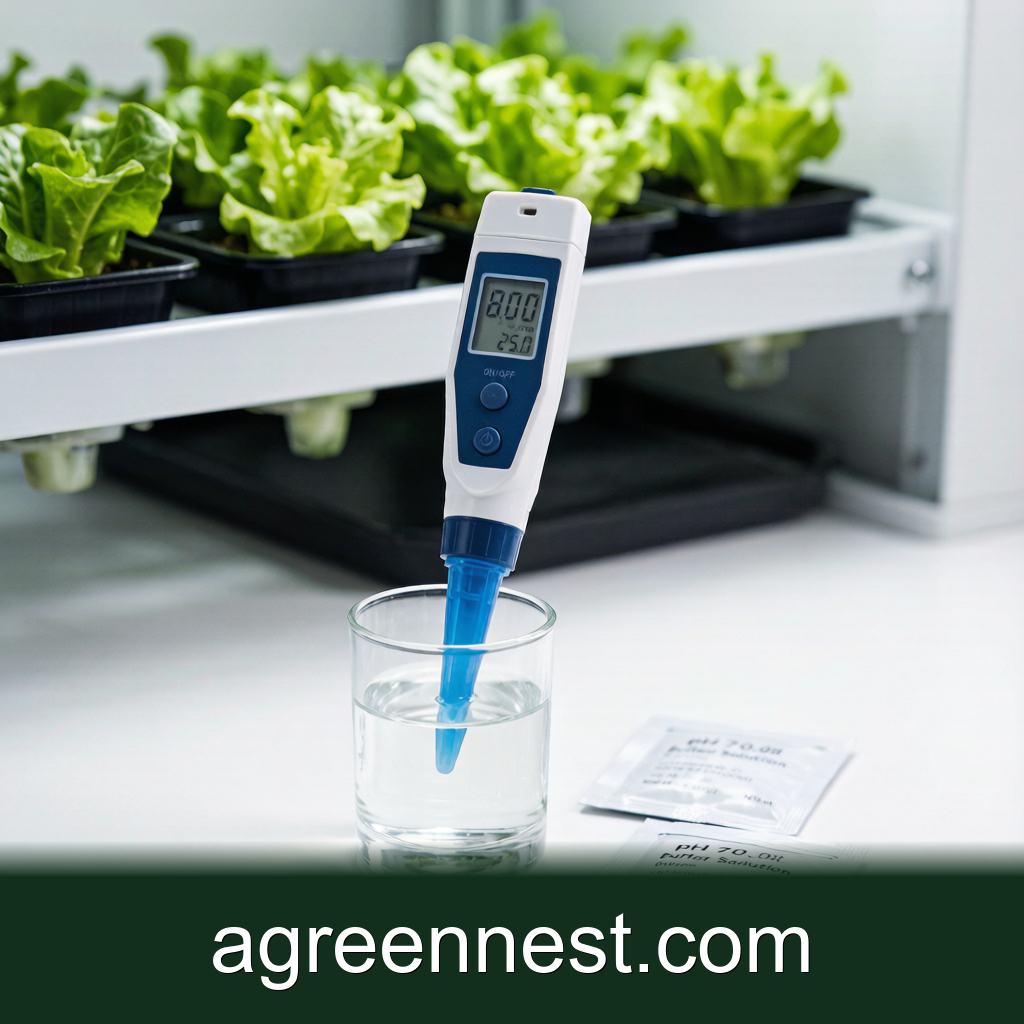
Calibrate a pH pen with two buffers, 7.0 first and then 4.0, every 2 weeks for hydroponics or before any critical mix. Rinse the bulb with distilled water between buffers, never wipe the glass, and store the tip in KCl storage solution. A pen that drifts more than 0.3 within a week needs a new probe or a new pen.
A reader sent me two photos of the same reservoir, taken 40 seconds apart with two pH pens. One read 5.4, the other 6.9. Which pen was lying? Possibly both. Neither had been calibrated in four months, and one had been stored dry in a kitchen drawer, which for a glass electrode is a slow execution.
A pH pen is a consumable instrument built around a glass membrane that ages from the day it leaves the factory, and it reads correctly only relative to its last calibration. The routine below takes five minutes and a few cents of buffer. Nutrient lockout starts within roughly 0.5 pH of your target band, so a pen off by 0.8 is steering you into deficiencies; see my pH management guide for what lockout looks like.
Why Does a Brand-New pH Pen Read Wrong?
Because factory calibration does not survive shipping and shelf time. The glass bulb hydrates and drifts, warehouse temperature swings shift the reference junction, and cheap pens are calibrated in bulk months before you open the box. Of the last four pens I bought for testing, the worst read 0.6 high out of the packaging; the best was 0.15 off.
Rule one: calibrate before first use, no matter what the listing claims. Rule two: recalibrate on a schedule, not on suspicion. My working intervals:
- Hydroponics with weekly reservoir changes: every 2 weeks, and before mixing any reservoir from scratch.
- Occasional soil or tap-water checks: monthly.
- After any drop, dry-out, or insane reading: immediately.
What You Need Before You Start
Four items, about $15 total if your pen did not ship with sachets:
- pH 7.0 buffer (some kits use 6.86; either works if you tell the pen which standard it is).
- pH 4.0 buffer (or 4.01). Two points bracket the acidic range where hydro operates, 5.5 to 6.5.
- Distilled or RO water in a squeeze bottle for rinsing. Tap water carries minerals that skew the buffer on contact, the same reason tap versus RO matters for your reservoir.
- KCl storage solution for the cap. Not distilled water, and never dry.
Buffers are single-use once poured. Pour 20 ml into a shot glass, use it, discard it. Dipping into the stock bottle contaminates the supply, and contaminated buffer is how people "calibrate" a pen into being wrong.
The 5-Minute Two-Point Calibration
Exact sequence, in the order that matters:
- Take the buffers and pen to room temperature, around 20-25 °C. Automatic temperature compensation (ATC) corrects the electrode's response, not a cold buffer's actual value; a 7.0 buffer at 10 °C is not sitting at 7.0.
- Rinse the bulb with distilled water and shake off the drops. Do not wipe. Rubbing the glass builds static charge and micro-scratches; both corrupt readings for hours.
- Dip in pH 7.0 buffer first, swirl for 5 seconds, then wait until the reading stops moving, typically 30-60 seconds. Confirm the point in calibration mode. Neutral first is not superstition: the pen sets its zero offset at 7.0, then uses the second buffer to set slope.
- Rinse again, then repeat in pH 4.0 buffer. Confirm the second point.
- Sanity-check. Rinse, then read the 7.0 buffer as a plain measurement; it should land within 0.05. If your pen shows slope percentage, healthy is 85-105%. Below 80%, the probe is dying regardless of what the display promises.
That is the whole ceremony. From cap off to cap back on, mine averages 4 minutes 30 seconds; I timed it because readers accuse me of underestimating.
One habit upgrade: calibrate before you mix nutrients, not after. Mixing A and B concentrates to a target EC on a fictional pH baseline wastes the batch, and misdosed pH quietly drives deficiency symptoms that appear despite fresh nutrients.
How Should You Store a pH Pen Between Uses?
Bulb wet, always, in KCl storage solution. That is the entire rule, and it is the one most people break.
The glass membrane works because its outer few nanometres stay hydrated as a gel layer. Let it dry for a week and that layer collapses; sometimes a 24-hour soak in storage solution revives it, often it never reads stably again. The sponge pad inside the cap exists to hold storage solution against the bulb; re-wet it monthly.
Three storage mistakes, ranked by damage:
- Dry drawer storage: kills probes in weeks to months. The number one reason "my pen worked last season and now jumps around".
- Storing in distilled water: slow damage; it pulls KCl out of the reference junction. Tap water is less harmful than distilled here, though still not correct.
- Leaving it standing in the reservoir: salts and biofilm coat the junction. If your reservoir also clouds up, the two problems feed each other; see what cloudy water is telling you.
If the bulb has salt crust, soak it in warm tap water for 10 minutes, then in storage solution overnight. No brushing, no vinegar unless the manufacturer allows a dilute acid wash.
When Calibration Won't Hold: Replace or Repair?
Glass electrodes last roughly 1 to 2 years, less with heavy use in warm nutrient solution. A probe at end of life shows a clear pattern:
- Calibration succeeds but drifts more than 0.3 within days.
- Response gets slow: 3+ minutes to settle where 30 seconds used to do.
- Readings wobble without ever settling.
- Slope below 80% at calibration.
On a $50+ meter with a replaceable probe, a new probe module ($15-30) resets the clock. On a $12-20 sealed pen, replacing the whole unit is the honest economics. My rule for budget pens: treat them as an 18-month consumable and verify any new pen against buffer before trusting it. A mid-range pen with ATC, a replaceable electrode, and 0.01 resolution is the sweet spot for year-round hydro.
Skip pH strips as your primary tool. Strips resolve to about 0.5 pH at best, and the reservoir game is played inside a 1.0-wide band. They are a sanity check when you suspect the pen, nothing more.
Frequently Asked Questions
Q: My pen reads 7.0 buffer fine but disagrees with my drop-test kit in nutrient solution. Which is right?
A: Usually the pen. Drop kits shift colour in tinted nutrient solution, and reading a colour chart in artificial light adds another 0.3 of human error. If the pen calibrates cleanly on two points with healthy slope, trust it over any colour comparison.
Q: Can I reuse buffer solution if it looks clean?
A: For rough checks, once or twice the same day, capped. For actual calibration, no. Poured buffer starts absorbing CO2 and picking up carryover, and 4.0 buffer grows mould over weeks. At roughly $0.30 per sachet, reused buffer is a bad trade against a misdosed reservoir.
Q: Do I really need 4.0 buffer, or is one-point calibration at 7.0 enough?
A: One-point fixes the offset but not the slope, so accuracy degrades the further you measure from 7.0. Hydro targets sit at 5.5-6.5, and single-point calibration leaves up to 0.2-0.3 of error right there. Two points, always, for reservoir work.
Q: My pen has no ATC. Is it useless?
A: No, just stricter about procedure. Calibrate and measure at the same temperature, ideally 20-25 °C for both buffer and sample. The error from a 10 °C mismatch is around 0.05-0.1 pH, which matters at the edge of a target band. Let a cold sample warm up before you read it.
Two buffers, neutral first, rinse without wiping, store the bulb in KCl, and set a phone reminder for every second Sunday. That routine keeps a $20 pen honest for its 18-month life and your reservoir chemistry running on real numbers instead of confident guesses. If your source water is part of the mystery, profile it with our water quality guide.
Sources & further reading
GreenNest authors research and write every guide independently. The external links below are reputable references we recommend for deeper reading — they are not the sources we copied from.
- Michigan State University — College of Agriculture & Natural Resources — Michigan State University
- University of Minnesota Extension — U Minnesota Extension
- NC State Extension Plant Toolbox — NC State Extension
Recommended Tools for Plant Care Accessories Care
Free, no-signup helpers matched to this guide.
Free Ebooks to Explore
Downloadable handbooks — no email required.
Free Ebook
The AGreenNest Succulent Care Handbook
The complete, beginner-to-confident guide to growing fat, happy succulents — 10 chapters and a 20-plant directory.
Free Ebook
Haworthia & Haworthiopsis Care Handbook
A focused guide to the striped, forgiving Haworthia clan.
Share Your Plant Story
Grown something tricky, or found a trick that finally worked? Tell us in the comments, or see what other readers are sharing on our Community page. The best reader tips get folded back into our guides.
Join the Conversation
Have a tip or a question about pH Pen Calibration: 5-Minute Routine That Holds? Share it below — comments are saved on our server.