 AGreenNest
Plant Styling & Display
Style a Coffee Table Plant Vignette That Lasts
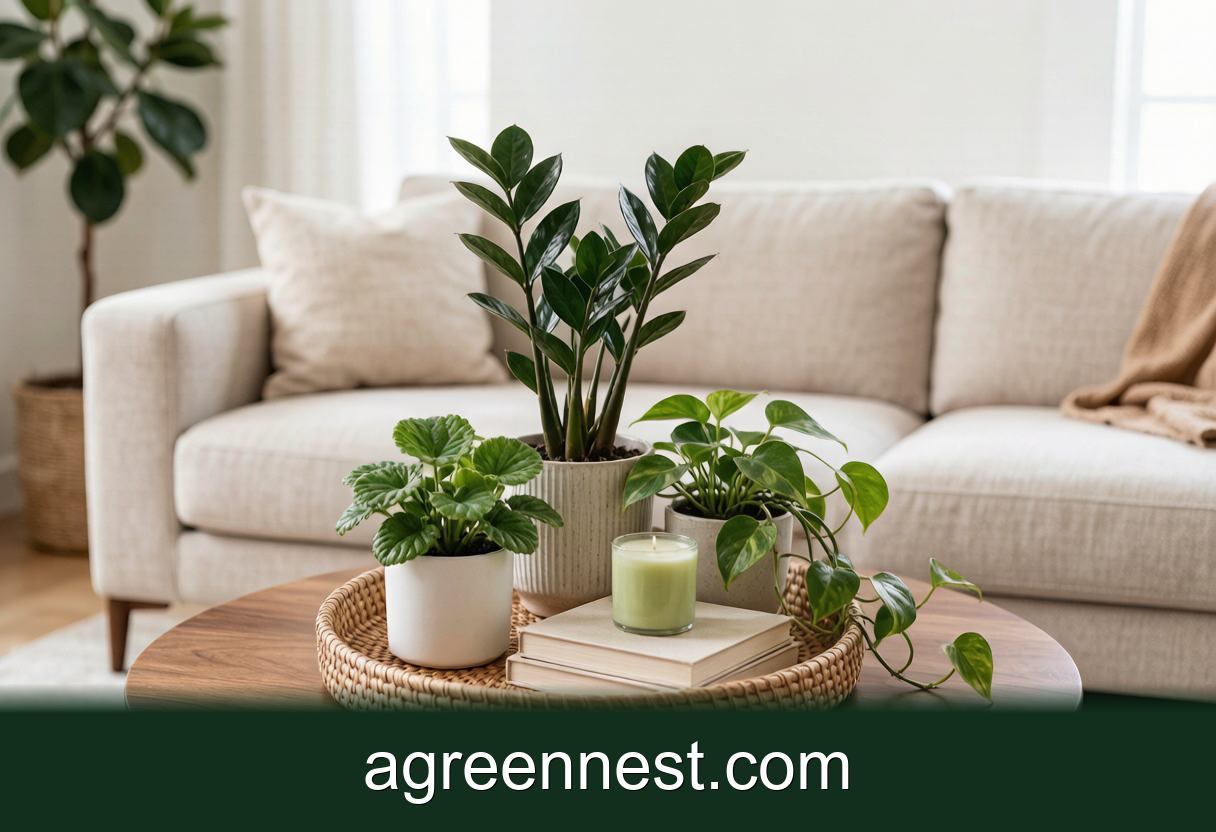
A coffee table vignette works best as a trio on a tray: one plant 20 to 30 cm tall, one mid-height texture plant, one trailer, plus a non-plant object. Keep the group under a third of the table surface, and choose species that tolerate the 100 to 500 lux most table centers actually get.
The first vignette I ever styled lasted four days. A gorgeous little Calathea orbifolia in the middle of my walnut coffee table, flanked by candles, exactly like the magazine spread I copied. Then my partner put a mug down, my cat treated the leaves as salad, and the calathea started crisping because the middle of a room is a light desert. The magazine never mentioned any of that.
A coffee table vignette is styling on hard mode. It sits in the worst light in the room, it competes with remote controls and coffee cups, and it gets viewed from every angle including from above. Get those three constraints right and the rest is play.
Start With the Light You Actually Have
Table centers usually sit 2 to 4 meters from the nearest window, and light falls off brutally with distance. Where a sill might read 5,000 lux on a bright day, the middle of the same room often measures 100 to 500 lux. That rules out most flowering plants and sun lovers before you touch a single pot.
Three plants I have kept happy on tables at that level:
- Zamioculcas zamiifolia, the ZZ plant. Glossy, architectural, and slow. A 25 cm specimen holds its shape for a year.
- Aspidistra elatior, the cast iron plant. Deep green paddles, tolerates 100 lux, reads beautifully from above.
- Epipremnum aureum 'Jade'. The plain green pothos outperforms variegated types in dim spots because it keeps more chlorophyll per leaf.
If you want to check your own table before buying, our window light estimator gets you close without a meter, and the fixes in best low light plants for a north window apply to dim table centers too. Rotate the arrangement a quarter turn each week so growth stays even; RHS guidance on houseplant placement makes the same point about one-sided light.
The Trio Rule: One Up, One Out, One Down
Odd numbers read as composed instead of arranged, and three is the sweet spot on a surface this small. My working formula after a decade of fussing:
- One up: a vertical plant 20 to 30 cm tall, never more than 40 cm. Taller than that and you block sightlines across the table, which is how vignettes get "temporarily" moved and never return.
- One out: a mid-height texture plant, 10 to 15 cm, with a different leaf shape. A Peperomia caperata next to a ZZ gives you ripple against gloss.
- One down: a small trailer that spills 10 to 20 cm over the tray edge. A young pothos or a Ceropegia woodii works; keep it trimmed so it does not creep toward the seating.
Vary heights by at least 10 cm between tiers, the same layering logic from plant height layering scaled down to tabletop size. Then add one non-plant object: a stack of two books, a ceramic bowl, a candle. The object gives the eye a rest and makes the group feel curated rather than hoarded.
Why a Tray Changes Everything
Every vignette that survives in my house lives on a tray, and it took me an embarrassing number of water rings to learn this.
A tray does four jobs. It catches drips and condensation, so your table finish survives. It defines the vignette's territory, so mugs and remotes have somewhere else to land. It lets you carry all three plants to the sink for watering in one trip. And it lets you slide the whole composition aside for game night in five seconds.
Size it at no more than one third of the table surface. On my 110 x 60 cm table that means a 35 x 25 cm rattan tray. Round trays suit rectangular tables; rectangular trays suit round ones. The contrast keeps things from looking like a furniture showroom.
One material note: terracotta breathes, which is lovely for roots and less lovely for wood, since moisture wicks through the clay base. Cork pads under each pot solve it, or use glazed cachepots. The trade-offs are the same ones covered in cachepot versus drainage pot. If your pots sit in cachepots, tip out any standing water 30 minutes after watering; Missouri Botanical Garden's houseplant help pages list sitting water as one of the fastest routes to rot.
What About Cats, Kids, and Coffee Cups?
Honest answer: the table is the most contested surface in the house, and the vignette needs to accept that.
For pets, skip anything toxic at mouth height. Zamioculcas and pothos both contain calcium oxalates, so if your cat is a chewer, swap them for a Peperomia obtusifolia and a spider plant, both listed as non-toxic. Our pet-friendly room styling guide has a fuller swap list, and NC State's Plant Toolbox is my go-to for double-checking toxicity on any species before it comes home.
For small children and clumsy guests, weight matters more than toxicity. A pot that weighs 1 kg or more will not tip when it gets bumped; anything lighter should sit in a heavier cachepot. And leave a clear landing zone of at least 20 cm along the sofa edge of the table. If people have nowhere to put a cup, they will make somewhere, usually inside your vignette.
How Do You Keep a Vignette Alive in Dim Light?
Plants in the middle of a room dry slower than plants near a window, sometimes half the speed. My table ZZ drinks roughly every 3 weeks in summer and closer to 5 in winter, while the pothos on the same tray wants water every 10 to 14 days. Group by pot, not by tray: check each plant with a finger 3 cm into the mix, or a probe if you prefer, and water only what needs it. A moisture meter earns its keep here because low light makes overwatering the default failure.
Dust is the quiet killer at table height. Leaves at 40 cm off the floor collect visibly more dust than shelf plants, and a dusty leaf in 200 lux is running on fumes. Wipe leaves monthly with a damp cloth; the glossy species repay you the same afternoon.
Every 6 months, audit. If the trailer has gone leggy or the upright has stretched, swap in a plant from a brighter room and rotate the tired one to recovery duty near a window. Vignettes are casting, not marriage.
Frequently Asked Questions
Q: My coffee table gets zero direct light. Can a vignette work at all?
A: Yes, with the toughest tier of plants: Aspidistra, ZZ, plain green pothos. Expect maintenance mode rather than growth, rotate plants to a bright window for a fortnight every couple of months, or add a small 5 W grow bulb in a nearby lamp.
Q: How do I stop water rings on a wooden coffee table?
A: Three layers of defense: water at the sink and drain fully before returning pots, use glazed cachepots or cork pads under terracotta, and keep everything on a tray with a lip. Never water in place on wood.
Q: Why does my table plant lean and stretch toward the sofa side?
A: It is growing toward the window behind the sofa. Quarter-turn the tray weekly. If new stems still stretch with 5 cm or more between leaves, the spot is too dim for that species; trade it for an Aspidistra or move it closer to the light.
Q: Should vignette plants share one big planter instead of three pots?
A: Separate pots, always, at this scale. A ZZ wanting water every 3 weeks cannot share soil with a pothos drinking every 10 days. Individual pots inside one tray give you the unified look with none of the root-zone compromise.
A coffee table vignette is a small stage with terrible lighting and a rowdy audience, and that is exactly why getting it right feels so good. Pick three tough plants at three heights, give them a tray to live on, and leave room for the coffee that names the table. Before you buy anything, run your room through our free light calculator so the cast matches the stage.
Sources & further reading
GreenNest authors research and write every guide independently. The external links below are reputable references we recommend for deeper reading — they are not the sources we copied from.
- Royal Horticultural Society — Houseplant care — RHS
- Missouri Botanical Garden — Missouri Botanical Garden
- NC State Extension Plant Toolbox — NC State Extension
Recommended Tools for Plant Styling & Display Care
Free, no-signup helpers matched to this guide.
Free Ebooks to Explore
Downloadable handbooks — no email required.
Free Ebook
The AGreenNest Succulent Care Handbook
The complete, beginner-to-confident guide to growing fat, happy succulents — 10 chapters and a 20-plant directory.
Free Ebook
Haworthia & Haworthiopsis Care Handbook
A focused guide to the striped, forgiving Haworthia clan.
Share Your Plant Story
Grown something tricky, or found a trick that finally worked? Tell us in the comments, or see what other readers are sharing on our Community page. The best reader tips get folded back into our guides.
Join the Conversation
Have a tip or a question about Style a Coffee Table Plant Vignette That Lasts? Share it below — comments are saved on our server.