 AGreenNest
Plant Styling & Display
Staircase Plant Styling: Steps, Landings, Banisters
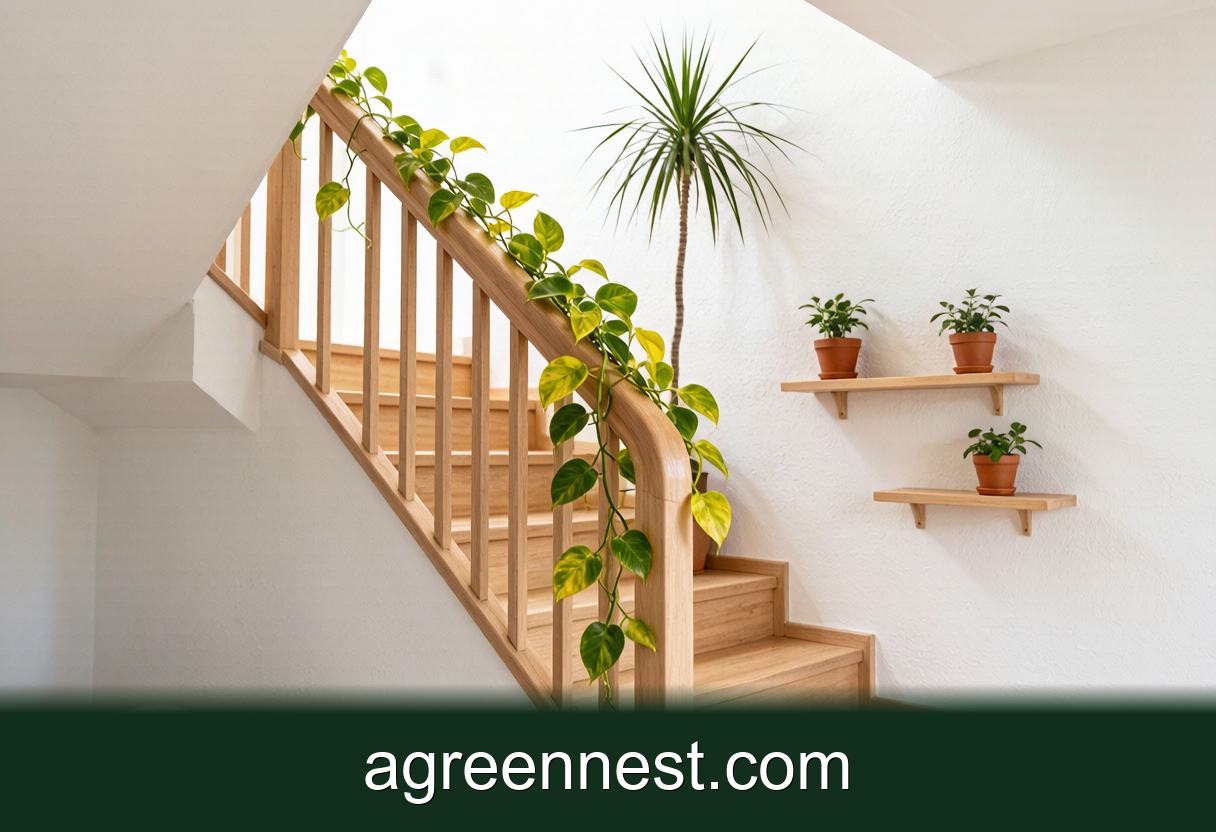
Style a staircase by placing plants where feet never land: the landing, the banister top, and the wall. Use one tall anchor like *Dracaena marginata* on the landing, trailers such as *Epipremnum aureum* along the banister, and keep every tread fully clear. Most stairwells sit at 300 to 800 lux, so choose low-light survivors.
There is a house on my street with a pothos running the full length of the banister, two floors of it, and every time I walk past at dusk with the lights on inside it stops me mid-stride. That one vine does more for the house than any piece of furniture in the window. Staircases are the most under-planted spot in most homes, and I understand why: nobody wants to trip over a pot at 6am. But the trick is not bravery. It is knowing which parts of a staircase are actually available.
Three zones are fair game. The landing, the banister, and the wall. The treads themselves are not, ever, and we will get to why.
Where Can Plants Go on a Staircase Without Being a Hazard?
Start with the rule I refuse to bend: nothing living, and no pot, saucer, or trailing stem, on any step you walk on. A pot on a tread is a broken ankle waiting for a dark morning. The UK's home-safety statistics put stairs at the top of the household accident list, and I am not adding to that with a jade plant.
That still leaves generous territory.
The landing is the star. A half-landing or top landing usually has 60 to 100cm of dead corner space where a floor plant can stand without touching the walking line. Measure the path people actually take, then keep pots at least 15cm clear of it.
The banister and newel post come second. A trailing plant in a secured pot at the top of the stairs can send vines along the handrail's outer side, the side your hand never grips. Never let stems cross the gripping surface; in a stumble, the rail must be instantly grabbable.
The wall is the bonus zone. Floating shelves staggered up the stairwell wall, hung 25 to 30cm above the handrail line, put plants at eye level as you climb. My spacing method for those is the same one in floating shelf plant styling.
How Much Light Does a Stairwell Actually Get?
Less than you think, usually. I have metered a dozen stairwells, mine and friends', and away from a window most read 300 to 800 lux in the middle of the day. A stairwell with a skylight or a tall window on the half-landing is a different animal, sometimes hitting 3,000 lux, so check before you buy anything fussy.
For the typical dim stairwell, lean on the plants that treat gloom as a lifestyle:
- Epipremnum aureum (pothos) for the banister run, the fastest and most forgiving trailer for the job. Details in pothos low-light care.
- Sansevieria trifasciata (snake plant) as an upright landing anchor that tolerates 300 lux without sulking.
- Aspidistra elatior (cast iron plant) for a shaded bottom corner.
- Dracaena marginata where you have height to fill; a 1.2 to 1.5m specimen on a landing draws the eye up the whole flight.
- Philodendron hederaceum for wall shelves, trailing 30 to 50cm per year even in modest light.
If your stairwell is a genuine cave, under 200 lux, a small clip-on grow light on a shelf bracket rescues the scheme. Run it 10 to 12 hours on a timer and the pothos will keep pushing new leaves through winter.
Styling the Climb: Rhythm, Repetition, and One Big Moment
A staircase is the one place in the house where people see your plants in motion, one after another, like frames of film. That changes the styling logic. Instead of one balanced tableau, you are building rhythm.
My formula is repetition plus a single moment. Repeat one plant, or one pot material, at intervals up the climb: say, a small terracotta pot on every second wall shelf. Repetition makes the flight feel intentional. Then give the journey a destination, one larger statement at the top landing, the Dracaena or a full pothos mother plant on a stand. The eye follows the repeats up to the payoff.
Keep pot materials to two at most. Stairwells are visually busy already, all angles and shadows, and a jumble of six pot styles reads as clutter in a way it would not on a bookshelf. I use the same restraint logic as in my plant grouping rules.
One more trick: hang length, not just height. A trailer spilling 40 to 80cm from a high shelf mirrors the diagonal of the stairs and makes the whole wall feel designed. More trailer candidates in trailing plants for shelves, and mounting ideas in hanging and trailing plant styling.
How Do You Water Plants on a Staircase Without a Mess?
This is the question that kills most stairwell schemes by month two, because watering a shelf 3m above the treads is genuinely annoying.
Do not water in place. Drips on a wooden stair are a slip hazard and a stain. I take every stairwell plant down on a fortnightly rotation, water it at the sink, let it drain 20 to 30 minutes, and carry it back. Cache pots with no drainage hole are the exception; they can be watered in place with a long-spout can, 100 to 150ml at a time, if you are disciplined about it.
Choose drought-tolerant species for the highest, most awkward shelves. The plant you need a step-ladder to reach should be the Sansevieria, not the fern. And group thirstier plants at the landing where access is easy, the same access-first logic I use in entryway plant styling.
Frequently Asked Questions
Q: Can I run a pothos vine along the actual handrail?
A: Along the outer side of the rail, yes, secured with removable clear clips every 30cm. Never across the top surface where hands grip. If anyone in the house grabs the rail hard in a stumble, they must find wood, not stems.
Q: My stairwell has no window at all. Is anything survivable there?
A: Below roughly 100 lux nothing thrives long-term, though a Zamioculcas zamiifolia will coast for months. Either add a timer-controlled grow light or rotate two identical plants weekly between the stairwell and a bright room.
Q: What size pot is safe on a half-landing without blocking the fire escape route?
A: Keep 90cm of clear passage as a working minimum, which usually means a pot footprint of 25 to 30cm tucked into the corner. If you cannot keep 90cm clear, style the wall instead of the floor.
Q: Do wall shelves need special fixing in a stairwell?
A: Yes. A watered 15cm pot weighs 2 to 3kg, and you cannot casually steady a wobbling shelf from a stair. Use proper wall anchors rated for at least 10kg per bracket, into studs or masonry, never just drywall plugs.
Q: Why do my stairwell plants lean so dramatically?
A: Stairwell light nearly always comes from one end, a window at the top or bottom, so plants stretch hard toward it. Give each pot a quarter turn every time you water and the lean stays subtle instead of structural.
A staircase asks for a different kind of styling: rhythm on the way up, one payoff at the top, and absolute respect for the walking line. Get those right and the most ignored space in the house becomes the best view in it. Before you buy for a dim stairwell, run your numbers through our free light calculator to see what will genuinely cope up there.
Sources & further reading
GreenNest authors research and write every guide independently. The external links below are reputable references we recommend for deeper reading — they are not the sources we copied from.
- Royal Horticultural Society — Houseplants — RHS
- Missouri Botanical Garden — Missouri Botanical Garden
- NC State Extension Plant Toolbox — NC State Extension
Recommended Tools for Plant Styling & Display Care
Free, no-signup helpers matched to this guide.
Free Ebooks to Explore
Downloadable handbooks — no email required.
Free Ebook
The AGreenNest Succulent Care Handbook
The complete, beginner-to-confident guide to growing fat, happy succulents — 10 chapters and a 20-plant directory.
Free Ebook
Haworthia & Haworthiopsis Care Handbook
A focused guide to the striped, forgiving Haworthia clan.
Share Your Plant Story
Grown something tricky, or found a trick that finally worked? Tell us in the comments, or see what other readers are sharing on our Community page. The best reader tips get folded back into our guides.
Join the Conversation
Have a tip or a question about Staircase Plant Styling: Steps, Landings, Banisters? Share it below — comments are saved on our server.