 AGreenNest
Plant Styling & Display
Summer Plant Styling: Rearrange for Heat and AC
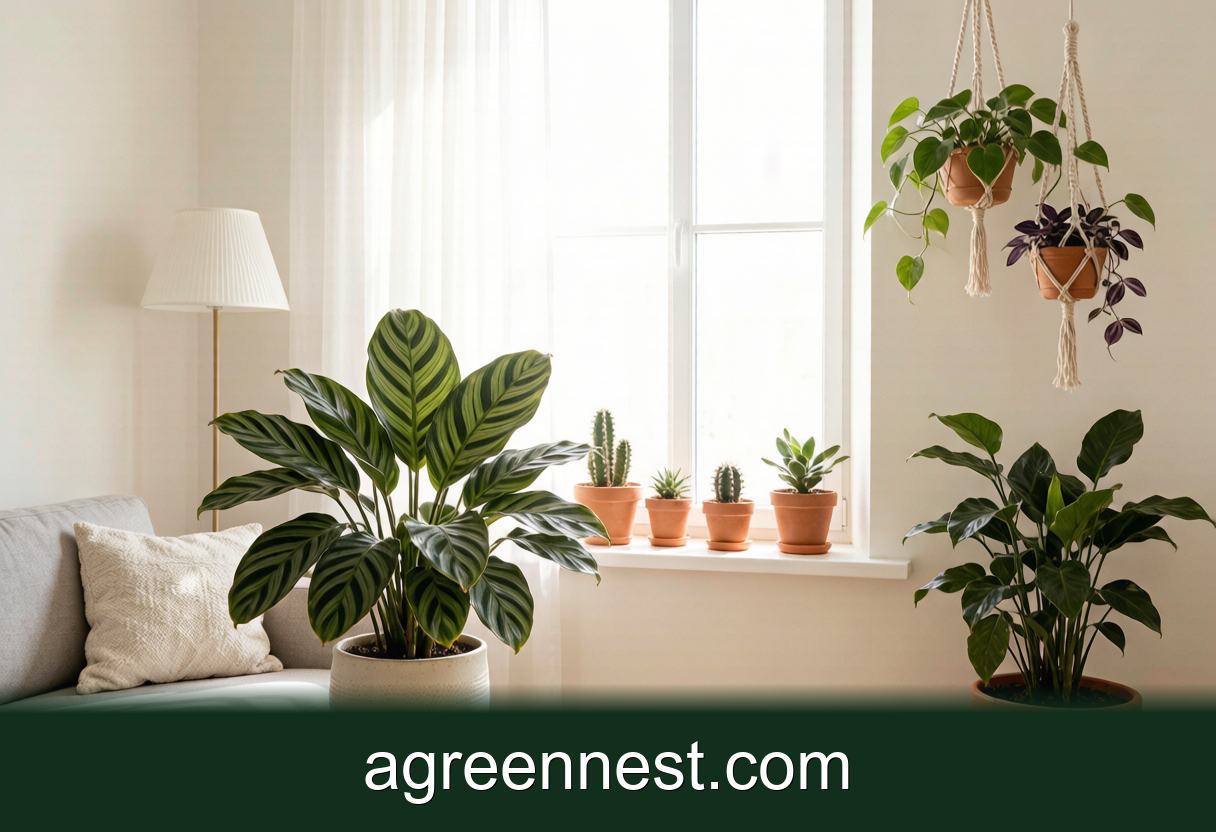
Summer changes two things in every plant-filled room: south and west windows get hot enough to scorch leaves, and air conditioning creates cold, dry drafts. Pull sensitive foliage 60-90 cm back from hot glass, keep everything at least 1.5 m from AC vents, and let sun-lovers take the prime spots until September.
The arrangement that looked perfect in April started falling apart in my flat by the last week of June. The Calathea orbifolia that spent all spring glowing on the west windowsill developed crisp bleached patches in the space of one heatwave weekend. The ficus by the AC unit dropped eleven leaves in a fortnight. Nothing was sick. The room had changed, and the plants were still styled for a season that had ended.
That is the thing about styling a plant collection: it is not a one-time decision, it is a seasonal one. Here is how I re-shuffle mine every June, room by room, and how the summer version of the room can look better than the spring one, not worse.
Which Windows Turn Hostile in Summer?
South and west windows, mostly. Glass concentrates heat, and a leaf resting near a west-facing pane on a 33°C afternoon can sit well above 40°C in the sun patch. Thin-leaved tropicals show it fastest: Calathea, Maranta leuconeura, ferns, and young Monstera deliciosa leaves all bleach or crisp within days.
My rule is a hand test at 4 pm on a sunny day. Hold your palm where the leaves are for 30 seconds. Uncomfortable on your skin means damaging to thin foliage. When it fails, I pull soft-leaved plants 60 to 90 cm back from the glass, or hang a sheer curtain, which cuts the harshest light by roughly half while keeping the room bright.
The vacated windowsill is not wasted. This is exactly where the sun-hungry crowd earns its summer promotion: Euphorbia trigona, jade, most cacti, and any succulents that stay in active summer growth. I treat it as a seasonal swap, sun worshippers forward, shade lovers back, and reverse it again in late September. If you are not sure which side of that line a window falls on, our window light estimator will settle it in a minute.
Where Can Plants Live Around Air Conditioning?
Nowhere within about 1.5 metres of a vent, is my honest answer, and further if the airflow points at the plant.
AC hits foliage with a double punch: the air is cold, often 15 degrees below room temperature at the vent, and it is dry, frequently under 40% relative humidity. Tropical foliage reads that as a cold, arid wind. The symptoms are sneaky because they look like underwatering: curling edges, brown tips, sudden leaf drop on ficus and Codiaeum. I lost two summers misdiagnosing my rubber plant before I finally blamed the vent above it.
When I restyle for summer I walk the room while the AC runs and feel for the draft path with damp hands, then keep leaves out of that corridor entirely. Grouping helps too. A cluster of 4 to 5 plants raises the humidity in its own pocket of air by a measurable margin, so summer is the season I merge my scattered singles into one lush group on a shelf or plant stand, which happens to be better styling anyway. A tight group of varied heights beats five lonely pots on five surfaces, a principle that carries straight through to autumn arrangements.
The Summer Silhouette: Go Vertical and Airy
Heat changes how a room feels, and dense, floor-heavy plant styling reads warmer than it is. My summer restyle borrows three moves from hot-climate interiors.
First, lift things. Trailing plants that pooled on shelves all winter go up on hooks and high shelves: Epipremnum aureum, Tradescantia zebrina, hoyas. Air moves under them, they catch the brighter summer ceiling light, and the floor opens up visually. Hanging and trailing arrangements do more work in July than any other month.
Second, thin the floor. I move one or two big floor plants to the bright corners that were too dim for them in December; a statement floor plant can hold a summer corner alone that needed three plants' worth of visual weight in winter.
Third, swap the pot palette. This is cosmetic, but it is the cheapest seasonal refresh there is: cachepots in terracotta, sand, and off-white make the same plants read cooler and brighter than the deep greens and charcoals I like in winter. Terracotta also breathes, which the roots appreciate in a 30°C room.
What About the Dim Rooms You Retreat To?
Summer has a funny side effect: people spend more time in their coolest, dimmest rooms, and suddenly want plants there. The bedroom with the blackout curtains, the north-facing office. You can style these, but stock them honestly: Sansevieria trifasciata, Zamioculcas zamiifolia, Aglaonema, and Epipremnum will hold their looks for months in poor light where a croton would sulk within weeks.
Two caveats from experience. Even shade-tolerant plants are surviving rather than growing in a dark corner, so I rotate them: two to three weeks in the dim room, then back to a bright recovery spot, with a twin plant swapping in. A matched pair of pots makes the rotation invisible to guests. And remember that summer heat reaches dim rooms too; warm plus dark is the combination that invites overwatering trouble, so pots in these rooms get half the water of their bright-room twins.
A 30-Minute Summer Restyle, Step by Step
- At 4 pm on a sunny day, hand-test every windowsill for 30 seconds each. Mark the fails.
- Pull thin-leaved tropicals 60 to 90 cm back from failed windows; promote cacti and other sun-lovers into those spots.
- Run the AC and trace the draft corridor. Move every plant out of it, minimum 1.5 m from vents.
- Merge scattered small plants into one or two grouped arrangements to build humidity pockets.
- Hang or raise at least two trailers; clear the equivalent floor space.
- Swap two or three cachepots to lighter colours. Water the dim-room plants last and lightest.
Do it once in late June and the arrangement coasts until the September reverse-shuffle.
Frequently Asked Questions
Q: My calathea got bleached patches on the west windowsill in one weekend. Can those leaves recover?
A: The bleached tissue will not turn green again. Move the plant 60-90 cm back or behind a sheer curtain, and once new leaves emerge you can trim the damaged ones at the base.
Q: How far from an AC vent is far enough for a fiddle leaf fig?
A: Keep it at least 1.5 m away and fully out of the direct airflow path. Ficus are the quickest droppers when hit by cold draft, so if it is still shedding leaves after a move, go further.
Q: Can I put my jade plant and cacti in the hot west window that scorched my other plants?
A: Yes, that is the ideal summer swap. Acclimatise over a week (a few hours of direct sun, then increase) so even sun-lovers do not scorch after months in a dimmer spot.
Q: Does grouping plants together really change humidity, or is that a myth?
A: Grouping genuinely raises humidity in the air pocket around the leaves through shared transpiration, typically by a modest 5-15%. It will not turn a desert into a greenhouse, but it takes the edge off AC-dried air, and it looks better than scattered singles.
Q: Should I move my houseplants outside for the summer instead?
A: You can, but move them gradually into shade first; direct outdoor sun is several times stronger than any windowsill and burns indoor-grown leaves within hours. Check pots for hitchhiking pests before bringing anything back inside in autumn.
Summer styling is really just honest styling: put each plant where July's light, heat, and airflow suit it, and let the room's look follow. The hand test, the draft walk, and one afternoon of shuffling will save you a season of mystery brown tips. If you want the light question answered with numbers instead of guesswork, run your worst window through our light calculator.
Sources & further reading
GreenNest authors research and write every guide independently. The external links below are reputable references we recommend for deeper reading — they are not the sources we copied from.
- Royal Horticultural Society — Houseplant care — RHS
- Missouri Botanical Garden — Missouri Botanical Garden
- NC State Extension Plant Toolbox — NC State Extension
Recommended Tools for Plant Styling & Display Care
Free, no-signup helpers matched to this guide.
Free Ebooks to Explore
Downloadable handbooks — no email required.
Free Ebook
The AGreenNest Succulent Care Handbook
The complete, beginner-to-confident guide to growing fat, happy succulents — 10 chapters and a 20-plant directory.
Free Ebook
Haworthia & Haworthiopsis Care Handbook
A focused guide to the striped, forgiving Haworthia clan.
Share Your Plant Story
Grown something tricky, or found a trick that finally worked? Tell us in the comments, or see what other readers are sharing on our Community page. The best reader tips get folded back into our guides.
Join the Conversation
Have a tip or a question about Summer Plant Styling: Rearrange for Heat and AC? Share it below — comments are saved on our server.