 AGreenNest
Plant Styling & Display
Styling Plants for Your Video Call Background
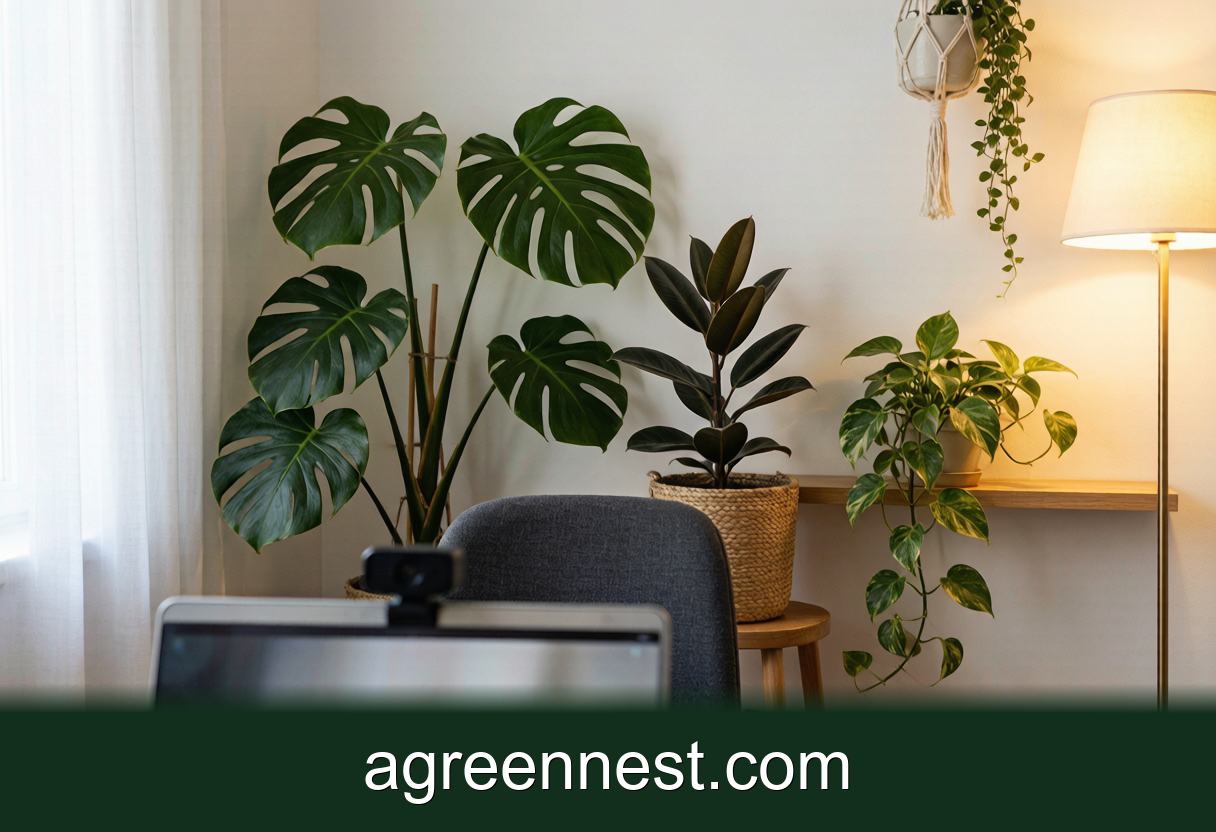
A video call background needs plants 1 to 2.5 m behind you, placed in the upper corners and one lower third of the frame. Large-leafed species like *Monstera deliciosa* and *Ficus elastica* read clearly at webcam resolution, while fine-leafed plants blur into green noise. Keep them out of your key light's path.
A colleague once stopped a meeting to ask about the plant behind my left shoulder. Not the agenda, the plant. It was a Monstera deliciosa I had shoved there twenty minutes earlier because the laundry rack usually lives in that corner, and I have been thinking about what cameras do to plants ever since.
Here is the uncomfortable truth I found after testing my own setup: most plant collections look worse on camera than in person. Webcams compress a room into a 720p or 1080p rectangle, flatten depth, and smear fine texture. The Asparagus setaceus that looks like green lace in real life becomes a fuzzy blob on screen. Styling a call background is its own discipline, closer to set dressing than interior design, and it follows different rules than styling a home office corner for the person sitting in it.
Which Plants Actually Read Well on a Webcam?
The camera rewards silhouette and leaf size, and punishes fine texture. My test was blunt: I put nine plants behind me one at a time, joined a call with myself on a second device, and screenshotted each frame at 1080p.
Winners, in order:
- Monstera deliciosa: leaf holes read as clear shapes from 2 m away. The single most camera-legible plant I own.
- Ficus elastica: broad 20 to 30 cm leaves with a glossy surface that catches light without glitter.
- Strelitzia nicolai: paddle leaves up to 50 cm long give strong vertical lines even when slightly out of focus.
- Epipremnum aureum trailing from a shelf: reads as a clean cascading line, not individual leaves, which is exactly what you want.
The losers were Asparagus setaceus (static fuzz), a small-leafed Ficus benjamina (visual gravel), and any succulent under 15 cm, which vanished from the frame. Small plants are not useless, but they need grouping to register, and the grouping logic from plant grouping rules applies double on camera: odd numbers, one dominant shape, tight clusters.
Where in the Frame Should Plants Sit?
Think in thirds, because your camera does. Your head and shoulders occupy the centre; the usable plant zones are the two upper corners and one lower side band.
My working layout after far too many test calls:
- One tall anchor (floor plant, 1.5 to 1.8 m) filling an upper corner, its foliage entering the top sixth of the frame. This frames your head without competing with it.
- One mid-height accent (60 to 90 cm, plant on a stool or plant stand) on the opposite side, lower third of frame.
- Optional trailing line along a shelf edge behind your shoulder, following the ideas in hanging and trailing styling but with the vines cut to a tidy 40 to 60 cm so they read as a line, not a tangle.
Distance matters more than people expect. Plants 1 to 2.5 m behind you get gentle background blur on most laptop cameras, which flatters foliage. Anything within arm's reach shows every dust speck and crispy edge in focus. And a leaf brushing your shoulder on camera reads as clutter, not lushness.
Symmetry is the other trap. Two identical plants flanking you like ficus bodyguards looks staged within seconds. One strong corner plus one modest accent looks like a room someone lives in.
Why Do My Plants Look Grey and Dead on Camera?
Almost always: the light behind you is fighting the light on you. Webcams expose for your face. If the plant corner is much darker than your face, the camera crushes it toward grey-green mush; if a window sits behind the plants, the camera silhouettes them entirely.
The fix is arranging three layers of light:
- Key light on you: window or lamp in front of you, never behind.
- Fill on the plants: the corner should measure at least a quarter of the light hitting your face. In practice I aim a small warm lamp at the anchor plant. If the corner reads below about 500 lux on the home lux test, the camera sees mud.
- No raw source in frame: a bare bulb or bright window edge in shot forces exposure down and darkens everything else.
If the corner is genuinely dark, a small grow light on a timer solves both problems at once: the plants photosynthesise, and they are lit for your 9 a.m. call. A warm-white full-spectrum bar looks like ordinary decor on camera. Run it 8 to 10 hours on a timer, following the setup in the grow light timer guide, and switch it off for calls only if it strobes on camera; most quality LED bars do not flicker at webcam frame rates.
Keeping the Background Alive Between Mondays
A call background gets seen five days a week, so decline is public. Three habits keep mine presentable:
- Dust every second Friday. Glossy leaves on Ficus elastica lose their camera shine under a week's dust. Damp microfibre cloth, thirty seconds per plant.
- Rotate a quarter-turn weekly. Camera corners are usually room corners with one-sided light, and a plant that leans 15 degrees toward the window reads as sad on screen even when it is healthy.
- Water on a probe reading, not a calendar. Corner plants dry slower than windowsill plants; my anchor Strelitzia drinks weekly in July and barely fortnightly in January. A settles it in five seconds per pot.
Also keep one understudy. A healthy 60 cm pothos in a plain cachepot can step into any gap while a diva recovers off-camera. Cheap insurance for the plant corner your colleagues have already started to expect.
Frequently Asked Questions
Q: Do virtual backgrounds make real plants pointless?
A: Virtual backgrounds fringe and flicker around hair and shoulders, and most people can tell within seconds. A real plant corner never glitches. If your room genuinely cannot host plants, a printed photo backdrop beats a rendered beach, but even one real Monstera leaf entering the frame reads more credible than pixels.
Q: My camera faces the window and I can't move my desk. What placement works?
A: Put the plants between you and the window as a partial screen: a tall open plant like Strelitzia 1.5 m behind you diffuses the backlight into shapes instead of glare. Then raise your key light in front of you until your face outpaces the window. It will not be perfect, but it moves the shot from silhouette to moody.
Q: How tall a plant do I need behind a standard desk setup?
A: Your webcam sits at roughly 1.1 to 1.2 m when the laptop is on a riser, and the frame's top edge lands around 1.8 to 2 m on the back wall at 2 m distance. A floor plant of 1.5 to 1.8 m, or a 90 cm plant on a 60 cm stand, puts foliage into the upper corner where it frames rather than photobombs.
Q: Are fake plants a reasonable shortcut for a call background?
A: On camera, good fakes pass better than they do in person; blur hides plastic sheen. But they collect dust identically, fade unevenly, and you lose the one real advantage: growth. The corner that slowly changes over months is the one people comment on. Half-and-half works too, with the real plant nearest the light.
Q: Which plant survives a dim corner that only exists for the camera?
A: For corners under 800 lux, Epipremnum aureum and Aspidistra elatior hold their shape longest, and both tolerate the erratic care a background corner invites. Expect slow growth, not decline. Below 400 lux, nothing broad-leafed holds for more than a few months without a grow light on a timer.
A good call background is one anchor plant with a legible silhouette, one modest accent, light that reaches them, and two Friday minutes of dusting. That is the whole system. The camera flattens everything else you might fuss over. Before you buy the anchor, check what your corner can actually feed it with our free light calculator.
Sources & further reading
GreenNest authors research and write every guide independently. The external links below are reputable references we recommend for deeper reading — they are not the sources we copied from.
- Royal Horticultural Society — Houseplant care — RHS
- Missouri Botanical Garden — Missouri Botanical Garden
- NC State Extension Plant Toolbox — NC State Extension
Recommended Tools for Plant Styling & Display Care
Free, no-signup helpers matched to this guide.
Free Ebooks to Explore
Downloadable handbooks — no email required.
Free Ebook
The AGreenNest Succulent Care Handbook
The complete, beginner-to-confident guide to growing fat, happy succulents — 10 chapters and a 20-plant directory.
Free Ebook
Haworthia & Haworthiopsis Care Handbook
A focused guide to the striped, forgiving Haworthia clan.
Share Your Plant Story
Grown something tricky, or found a trick that finally worked? Tell us in the comments, or see what other readers are sharing on our Community page. The best reader tips get folded back into our guides.
Join the Conversation
Have a tip or a question about Styling Plants for Your Video Call Background? Share it below — comments are saved on our server.