 AGreenNest
Plant Styling & Display
Textured Leaf Plants: Styling Green Against Green
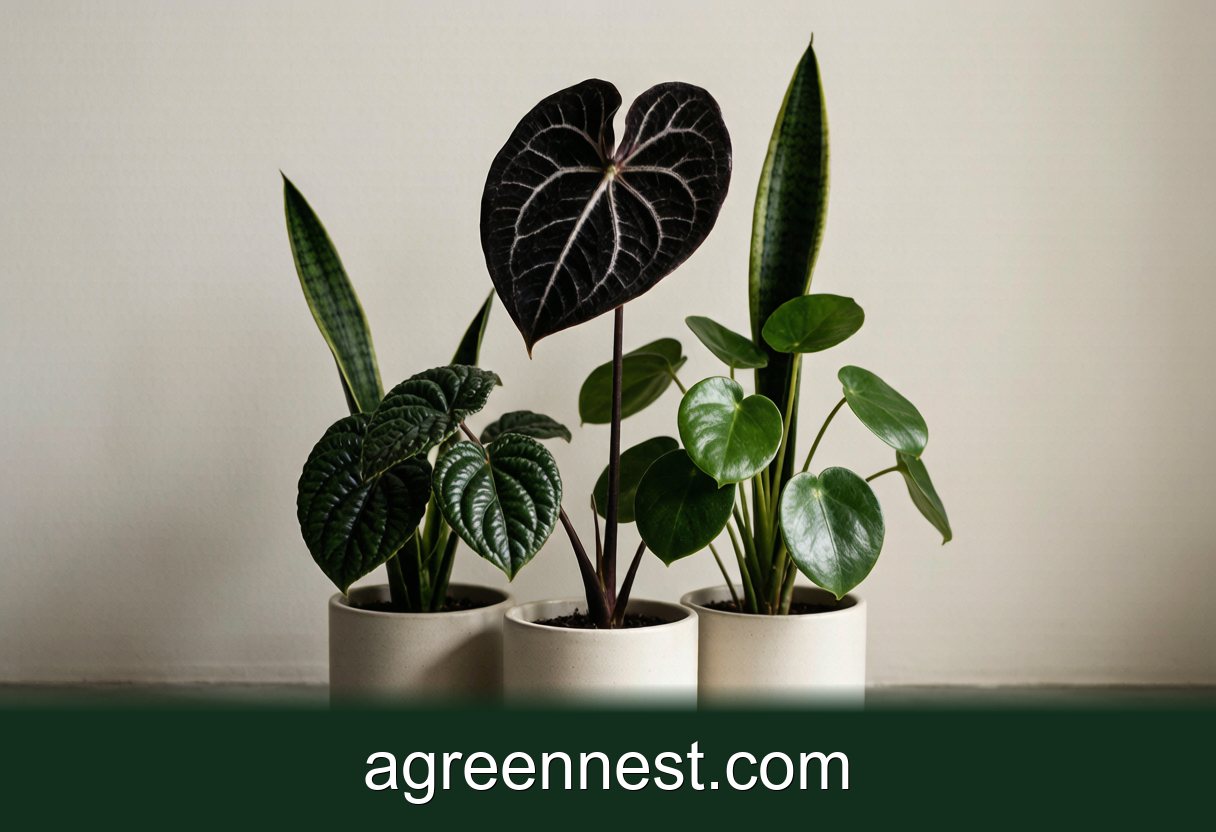
Grouping plants by leaf texture, not colour, is what gives an all-green corner depth. Combine one matte plant, one glossy plant and one velvet or quilted plant, keep them within 60 cm of each other so the eye reads them together, and dust the leaves monthly so the surfaces stay legible.
I spent a whole autumn convinced my living room corner needed another plant. It had seven. Every one healthy, every one green, and in photographs the whole arrangement collapsed into a single flat shrub. My friend Ilse, who paints, looked at it for about four seconds and said the problem was that everything reflected light the same way.
She was right. I swapped one glossy pothos for a velvet-leaved Anthurium clarinervium and moved a matte Sansevieria trifasciata to the front, and the corner suddenly had three distances in it. No new colours. Just surfaces that catch light differently.
Why Does an All-Green Corner Still Look Flat?
Our eyes read depth partly through specular highlight, the bright spot where light bounces off a surface. A glossy leaf throws a hard white highlight. A matte leaf throws almost none and reads as a soft silhouette. A velvet leaf absorbs light and goes nearly black in the shadows, which pushes it visually backwards.
Put five glossy plants together and every leaf returns the same highlight at the same angle. The brain has nothing to separate them with, so it merges them into one mass. That is the flat-shrub effect, and it is why adding an eighth glossy plant never fixes it.
Texture also survives what colour does not. Variegation fades in low light, and coloured foliage often reverts. A quilted leaf stays quilted at 200 lux or 2000. If your room is on the dim side, texture is the more reliable design tool, and the lux test for how dark your home really is will tell you which end you are working at.
The Four Textures Worth Collecting
Matte. Sansevieria trifasciata and Zamioculcas zamiifolia in its matte forms. These read as clean shapes, so they hold the front of a group without competing. Matte foliage is also the most forgiving of dust, which matters more than people expect.
Glossy. Pilea peperomioides with its 8 to 10 cm coins, Ficus elastica, Philodendron hederaceum. Glossy leaves are your highlights. One or two per group. More than that and you are back to the flat shrub.
Velvet. Anthurium clarinervium, Alocasia 'Frydek', Philodendron micans. The leaf surface carries tiny papillae that scatter light, giving a nap like fabric. These are the depth-makers, and they are the ones guests reach out to touch. Micans in particular shifts from bronze to deep green depending on where you stand.
Quilted or puckered. Begonia masoniana, Peperomia caperata, Calathea orbifolia with its wide ribbed blades. The surface is a landscape of small hills, so a single leaf contains its own light and shadow. One quilted plant does a lot of work; the iron cross begonia and emerald ripple peperomia are the two I keep recommending to people who want the effect without a humidity project.
Which Textured Plants Cope With Ordinary Light?
This is where the styling magazines quietly cheat, because velvet aroids photograph beautifully and sulk in a north room. My honest sorting, measured with a meter at leaf height at midday:
- Below 300 lux: Sansevieria trifasciata, Zamioculcas zamiifolia, Aspidistra elatior. Matte and tough. Growth is slow, appearance holds.
- 400 to 800 lux: Peperomia caperata, Asplenium nidus, Philodendron micans, Begonia masoniana. This is the useful middle band, roughly 1.5 to 2 m back from an east window.
- 800 lux and up: Anthurium clarinervium, Alocasia 'Frydek', Calathea orbifolia. Give these a spot within 1 m of a bright window with a sheer, or supplement. A small panel at 40 cm for 10 hours a day covers a shelf group well.
Velvet leaves have one extra requirement worth knowing before you buy: those light-scattering hairs trap moisture, so water sitting on the surface overnight invites spotting. Water the soil, not the leaf, and keep them off cold windowsills below 15 °C. The RHS guidance on tropical foliage is blunt about draughts, and my own Alocasia proved it by dropping two leaves after a week beside a leaky sash.
Pairing Textures Without Making a Jumble
Three rules have survived years of rearranging in my flat.
Three textures, not five. One matte, one glossy, one velvet or quilted. A fourth is possible in a large group of seven or more plants, but below that it reads as clutter.
Repeat one texture twice. Two matte plants of different heights, then a single glossy and a single velvet. Repetition is what separates a designed group from a plant shop shelf. The height logic in layering plant heights stacks neatly on top of this.
Keep the group inside 60 cm. Beyond about that spacing the eye stops comparing the surfaces and starts seeing separate plants, and the contrast effect vanishes. Grouping distance does more for the look than any single plant choice, which is the same principle behind the plant grouping rules.
One thing to avoid: pairing a strongly quilted leaf with a heavily patterned pot. The pot pattern and the leaf surface fight, and the leaf loses. Plain, low-sheen containers let texture speak, which is the argument in matching pots versus mixed pots.
Keeping Texture Legible
Texture only exists if light rakes across it. Two practical habits keep the effect alive.
Light from the side, not overhead. A lamp or window at 30 to 45 degrees to the leaf surface throws the small shadows that make quilting visible. Straight-down light flattens everything, which is why plants under a ceiling spot always look duller than the same plants beside a window.
Dust monthly. A film of dust turns glossy into semi-matte and mutes every contrast you built. Glossy leaves take a damp microfibre cloth, one hand supporting the leaf. Velvet leaves must never be wiped wet: use a soft dry brush, the sort sold for makeup, in one direction only. Bird's nest fern crowns collect dust in the centre where you cannot reach, so tip the pot and rinse in a lukewarm shower every couple of months.
Frequently Asked Questions
Q: My *Anthurium clarinervium* has lost its velvet look and gone dull. What happened?
A: Usually mineral deposits from hard-water misting, or dust bound into the leaf hairs. Stop misting the foliage, then brush dry with a soft brush. If there is visible white scale on the surface, a very lightly damp cloth with distilled water, blotted immediately, will lift it. Do not scrub, since crushed papillae stay crushed.
Q: Can I get texture contrast if I only have room for two plants?
A: Yes, and matte plus quilted is the pairing I would choose. A Sansevieria trifasciata behind a Peperomia caperata gives you a hard silhouette against a broken surface at about 40 cm apart. Skip glossy in a two-plant group, because a single highlight looks accidental rather than intentional.
Q: Do textured leaves collect more pests than smooth ones?
A: Quilted and velvet surfaces do hide spider mites and mealybugs longer, mostly because you cannot see the underside crevices at a glance. Turn one leaf over during your monthly dusting. That habit alone catches most infestations while they are still a five-minute problem.
Q: My quilted begonia leaves are flattening out. Is that light or water?
A: Almost always light. Puckering develops as the leaf expands, so a leaf grown at 150 lux emerges smoother and stays that way. Move the plant into the 400 to 800 lux band and judge the new leaves, not the old ones, which will not re-texture.
Colour in a plant group is loud and hard to control. Texture is quiet, survives dim rooms, and does not revert on you. Start with one velvet or quilted plant in a corner that already has matte and glossy in it, and see how much depth arrives from a single swap. If you are not sure the corner has the light to hold a velvet aroid, check it first with our free light calculator.
Sources & further reading
GreenNest authors research and write every guide independently. The external links below are reputable references we recommend for deeper reading — they are not the sources we copied from.
- Royal Horticultural Society — Houseplant care — RHS
- Missouri Botanical Garden — Missouri Botanical Garden
- NC State Extension Plant Toolbox — NC State Extension
Recommended Tools for Plant Styling & Display Care
Free, no-signup helpers matched to this guide.
Free Ebooks to Explore
Downloadable handbooks — no email required.
Free Ebook
The AGreenNest Succulent Care Handbook
The complete, beginner-to-confident guide to growing fat, happy succulents — 10 chapters and a 20-plant directory.
Free Ebook
Haworthia & Haworthiopsis Care Handbook
A focused guide to the striped, forgiving Haworthia clan.
Share Your Plant Story
Grown something tricky, or found a trick that finally worked? Tell us in the comments, or see what other readers are sharing on our Community page. The best reader tips get folded back into our guides.
Join the Conversation
Have a tip or a question about Textured Leaf Plants: Styling Green Against Green? Share it below — comments are saved on our server.